

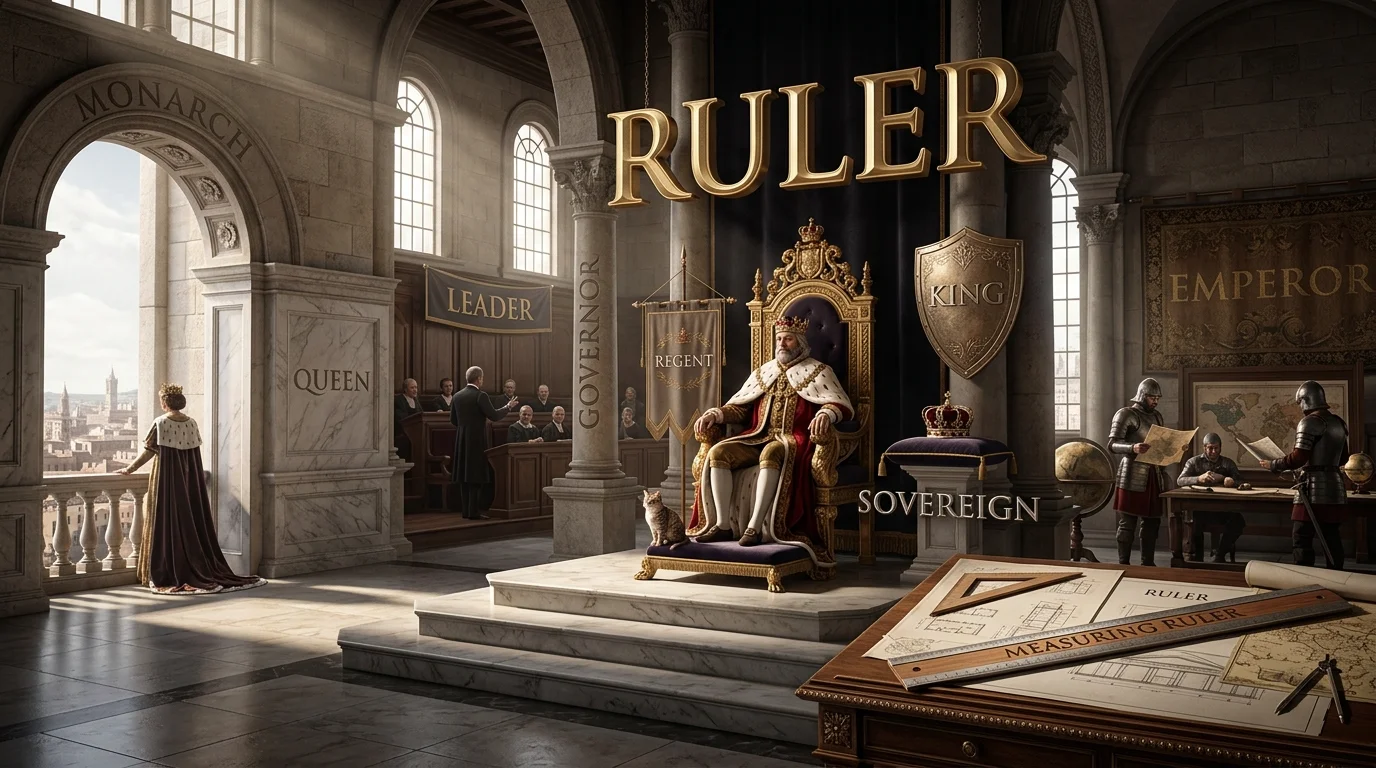
Quick List of Synonyms for Ruler
Ruler as a Person Who Governs
Leader
Monarch
Sovereign
King
Queen
Emperor
Empress
Governor
Regent
Potentate
Sovereign leader
Head of state
Head of government
Chieftain
Despot
Tyrant
Dictator
Autocrat
Overlord
Lord
Czar
Sultan
Pharaoh
Prince
Princess
Warlord
Supreme leader
Political leader
Administrator
Commander
Ruler as a Measuring Tool
Measuring rule
Straightedge
Measuring stick
Measuring scale
Yardstick
Meterstick
Measuring instrument
Graduated rule
Note: These alternatives are not all interchangeable. A monarch is a specific kind of ruler, while a tyrant describes someone who exercises power cruelly or oppressively.
Best Synonyms for Ruler and Their Meanings
1. Leader
Meaning: A person who guides a group, organization, or country.
How it differs: Leader is broader than ruler. A leader may influence people without having official governing power.
Tone: Neutral or positive.
Best for: General writing, politics, business, and group leadership.
Example: The leader introduced new policies to improve the country.
2. Monarch
Meaning: A king, queen, or another person who holds a monarchy’s highest position.
How it differs: A monarch rules within a monarchy, often through hereditary succession.
Tone: Formal and historical.
Best for: Royal families, history, and political systems.
Example: The monarch addressed the nation during the national celebration.
3. Sovereign
Meaning: A supreme ruler or a person who holds the highest authority in a state.
How it differs: Sovereign emphasizes supreme authority and independence. It can also refer to a state or nation possessing that authority.
Tone: Formal.
Best for: Constitutional discussions, international relations, and historical writing.
Example: The sovereign held considerable influence over national affairs.
4. King
Meaning: A male monarch who rules a kingdom or holds the title of king.
How it differs: King is more specific than ruler because it identifies a particular royal title.
Tone: Neutral, historical, or ceremonial.
Best for: Monarchies, fairy tales, and historical accounts.
Example: The king appointed new advisers to the royal council.
5. Queen
Meaning: A female monarch who rules a kingdom, or a woman who holds the title of queen.
How it differs: A queen may rule in her own right or hold the title as the wife of a king. The exact role depends on the monarchy.
Tone: Neutral or formal.
Best for: Royal history and political writing.
Example: The queen met with representatives from neighboring countries.
6. Emperor
Meaning: A monarch who rules an empire, traditionally a territory containing multiple regions or peoples.
How it differs: An emperor generally holds an imperial title rather than the title of king, although the exact powers vary by political system.
Tone: Formal and historical.
Best for: Ancient civilizations and imperial history.
Example: The emperor expanded his administration across the empire.
7. Empress
Meaning: A female ruler of an empire or a woman who holds the title of empress.
How it differs: The title identifies a particular imperial role, not every woman who exercises political authority.
Tone: Formal and historical.
Best for: Royal biographies and historical writing.
Example: The empress supported the construction of schools and public buildings.
8. Governor
Meaning: An official responsible for governing a state, province, or territory, depending on the political system.
How it differs: A governor usually has authority over a defined region rather than an entire sovereign country.
Tone: Formal and professional.
Best for: Government, news, and political reporting.
Example: The governor announced a new plan for regional development.
9. Regent
Meaning: A person who governs temporarily on behalf of a monarch who cannot rule, often because the monarch is too young or unavailable.
How it differs: A regent exercises delegated or temporary authority rather than necessarily being the rightful monarch.
Tone: Formal and historical.
Best for: Royal history and succession stories.
Example: The regent managed the kingdom until the young king came of age.
10. Potentate
Meaning: A person who possesses great power or authority, especially a ruler with extensive control.
How it differs: Potentate emphasizes considerable power and is less common in everyday English.
Tone: Formal and sometimes critical.
Best for: Historical writing and descriptions of powerful rulers.
Example: The potentate controlled much of the region’s political life.
11. Chieftain
Meaning: The leader of a tribe, clan, or traditional community.
How it differs: A chieftain’s authority is connected to a particular community or traditional leadership structure.
Tone: Historical or cultural.
Best for: Tribal histories and traditional societies.
Example: The chieftain gathered the community to discuss the dispute.
12. Despot
Meaning: A ruler who exercises power in an oppressive or absolute way.
How it differs: Unlike the neutral word ruler, despot carries a strongly negative meaning.
Tone: Critical.
Best for: Political criticism and historical analysis.
Example: The despot silenced critics and restricted public freedoms.
13. Tyrant
Meaning: A ruler who uses power cruelly, unjustly, or oppressively.
How it differs: Tyrant highlights abusive behavior rather than simply describing someone’s position.
Tone: Strongly negative.
Best for: Political commentary, historical accounts, and fiction.
Example: The tyrant punished anyone who openly opposed his decisions.
14. Dictator
Meaning: A leader who holds extensive political power without meaningful democratic checks.
How it differs: Dictator describes a particular form of political control. It is not a general substitute for every monarch or governor.
Tone: Usually critical or politically descriptive.
Best for: Government, history, and political analysis.
Example: The dictator restricted political opposition and controlled the media.
15. Autocrat
Meaning: A ruler who exercises power largely without being accountable to other governing authorities.
How it differs: Autocrat emphasizes concentrated personal power and limited checks on authority.
Tone: Formal and often critical.
Best for: Political science and analytical writing.
Example: The autocrat made major decisions without consulting the legislature.
16. Overlord
Meaning: A person who holds superior authority over other rulers or territories, especially in historical systems of hierarchy.
How it differs: Overlord often implies dominance over subordinate rulers or subjects.
Tone: Historical, dramatic, or sometimes humorous.
Best for: Medieval history and fantasy writing.
Example: The overlord demanded loyalty from the surrounding lords.
17. Warlord
Meaning: A military leader who controls a territory through armed force, particularly where central government authority is weak.
How it differs: A warlord’s power is commonly based on military strength rather than a recognized constitutional or royal position.
Tone: Usually negative or conflict-related.
Best for: Conflict reporting and historical writing.
Example: The warlord maintained control over the territory through armed groups.
18. Head of State
Meaning: The person who officially represents a country’s highest state authority.
How it differs: A head of state may be a monarch or president and does not always control the day-to-day government.
Tone: Formal and institutional.
Best for: Government and international relations.
Example: The head of state welcomed the visiting delegation.
19. Head of Government
Meaning: The person responsible for leading a country’s government, such as a prime minister.
How it differs: The head of government directs government operations, while the head of state may perform a separate constitutional role.
Tone: Formal.
Best for: Political reporting and government documents.
Example: The head of government presented the annual policy agenda.
20. Straightedge
Meaning: A straight-edged tool used to draw straight lines or check straightness.
How it differs: A straightedge does not necessarily have measurement markings, unlike a conventional ruler.
Tone: Neutral and technical.
Best for: Drawing, geometry, design, and construction.
Example: Use a straightedge to draw a clean line across the page.
21. Measuring Stick
Meaning: A stick marked with units used to measure length or distance.
How it differs: A measuring stick is usually longer or more rigid than an ordinary handheld ruler.
Tone: Neutral.
Best for: Crafts, construction, and practical measurement.
Example: She used a measuring stick to check the width of the wooden board.
22. Yardstick
Meaning: A measuring tool one yard long, or a standard used to judge something.
How it differs: Yardstick can be literal or figurative. In the figurative sense, it means a benchmark, not a political ruler.
Tone: Neutral.
Best for: Measurement and evaluation.
Example: Customer satisfaction became the yardstick for measuring the team’s success.
23. Meterstick
Meaning: A measuring tool one meter long, usually marked in metric units.
How it differs: A meterstick is a specific measuring tool, while ruler can refer to tools of different lengths.
Tone: Neutral and technical.
Best for: Science classrooms, workshops, and metric measurement.
Example: The students used a meterstick to measure the table.

Ruler Synonyms by Context
| Context | Best alternative | Why it fits |
|---|---|---|
| General leadership | Leader | Broad and widely applicable |
| Royal government | Monarch | Identifies a ruler in a monarchy |
| Supreme political authority | Sovereign | Emphasizes highest authority |
| Regional administration | Governor | Specifies regional responsibility |
| Temporary royal government | Regent | Describes delegated authority |
| Oppressive leadership | Tyrant | Highlights cruelty and abuse |
| Concentrated political power | Autocrat | Emphasizes unchecked authority |
| Military territorial control | Warlord | Highlights force-based control |
| Official national representation | Head of state | Identifies a constitutional role |
| Drawing straight lines | Straightedge | Focuses on straightness, not measurement |
| Measuring length | Measuring stick | Describes a physical measuring tool |
| Evaluating performance | Yardstick | Means a standard or benchmark |
True Synonyms vs. Related Alternatives
Not every word associated with ruler has the same meaning.
| Alternative | Relationship | Can replace “ruler”? | Tone | Best context |
|---|---|---|---|---|
| Monarch | Specific type of ruler | Yes, for a monarch | Formal | Royal government |
| Sovereign | Close alternative | Usually, in the right context | Formal | Supreme authority |
| Leader | Broader alternative | Sometimes | Neutral | General leadership |
| Governor | Specific public official | Only when the role fits | Professional | Regional government |
| Regent | Temporary or delegated ruler | Only when the role fits | Formal | Royal succession |
| Tyrant | Negative characterization | Only when oppressive behavior is intended | Critical | Abusive rule |
| Dictator | Specific political role | Only when the description fits | Critical or descriptive | Authoritarian government |
| Straightedge | Related measuring/drawing tool | Only for the relevant tool sense | Technical | Drawing |
| Yardstick | Specific tool or figurative standard | Only in the relevant sense | Neutral | Measurement or evaluation |
| Commander | Related authority role | Sometimes, in military contexts | Formal | Military leadership |
Ruler vs. Leader vs. Monarch
Ruler vs. leader: A ruler exercises governing authority, while a leader may simply guide, inspire, or organize people. A team captain can be a leader without being a ruler.
Ruler vs. monarch: A monarch is a ruler who holds a royal position in a monarchy. Not every ruler is a monarch; presidents and military dictators can also govern countries.
Ruler vs. sovereign: A sovereign is associated with supreme authority. The word can refer to a monarch, but it also appears in legal and political discussions about the independence of states.
Ruler vs. tyrant: A ruler is a neutral term for someone who governs. A tyrant is a ruler characterized by cruel or oppressive behavior.
Which Synonym for Ruler Should You Choose?
For a general description: Choose leader when you mean someone who guides people, or ruler when governing authority matters.
For a king or queen: Choose monarch when you want a gender-neutral general term for royal rule.
For formal political writing: Choose sovereign, head of state, or head of government according to the person’s actual role.
For an oppressive ruler: Choose tyrant or despot when the negative judgment is intended.
For a person with unchecked political power: Choose autocrat when you want to emphasize concentrated authority.
For a regional official: Choose governor if the person holds that specific office.
For a measuring tool: Choose measuring stick, meterstick, or yardstick based on the tool and measurement system.
For drawing without measuring: Choose straightedge when the markings are not important.
Sentence Transformations Using Synonyms for Ruler
Example 1: General Leadership
Original: The ruler addressed the people.
Better alternative: The leader addressed the people.
Why: Leader sounds broader and does not necessarily imply formal governing power.
Example 2: Royal Authority
Original: The ruler inherited the throne.
Better alternative: The monarch inherited the throne.
Why: Monarch identifies a royal position more precisely.
Example 3: Regional Government
Original: The ruler announced a new regional policy.
Better alternative: The governor announced a new regional policy.
Why: This works if the person is officially responsible for governing that region.
Example 4: Oppressive Government
Original: The ruler punished people who criticized him.
Better alternative: The tyrant punished people who criticized him.
Why: Tyrant adds a strong negative judgment about the ruler’s behavior.
Example 5: Concentrated Power
Original: The ruler made every major decision alone.
Better alternative: The autocrat made every major decision alone.
Why: Autocrat emphasizes the concentration of political power in one person.
Example 6: Temporary Royal Authority
Original: The ruler governed until the prince became an adult.
Better alternative: The regent governed until the prince became an adult.
Why: Regent is the more precise term if the person governed on behalf of the young heir.
Example 7: Measuring a Board
Original: He used a ruler to measure the board.
Better alternative: He used a measuring stick to measure the board.
Why: Measuring stick describes the tool’s function, although the best term depends on its actual size and design.
Example 8: Drawing a Line
Original: Use a ruler to draw a straight line.
Better alternative: Use a straightedge to draw a straight line.
Why: Straightedge emphasizes drawing a straight line rather than measuring its length.
Example 9: Measuring Success
Original: The ruler of success was customer satisfaction.
Better alternative: The yardstick for success was customer satisfaction.
Why: Yardstick is a natural figurative alternative meaning a standard for evaluation. The original wording is not idiomatic in this context.
Common Mistakes When Choosing a Synonym for Ruler
Using monarch for every political leader. A president or governor is not necessarily a monarch. Use the title that matches the political system.
Using leader when governing authority is essential. A leader may guide a group without having formal power to govern.
Calling every ruler a tyrant. Tyrant implies oppressive behavior, so it should not be used as a neutral title.
Confusing dictator with monarch. These terms describe different political roles or systems, even though their powers may overlap in some situations.
Using governor for a national monarch. A governor generally oversees a region or administrative area, not necessarily an entire sovereign country.
Confusing a ruler with a straightedge. A straightedge helps draw or check straight lines and may have no measurement markings.
Using yardstick only literally. The word also means a standard for evaluating performance, quality, or success.
Treating sovereign as a perfect substitute in every sentence. Sovereign has legal and political meanings that may not fit casual references to a leader.
Replacing ruler just to avoid repetition. Repeating ruler is often clearer when the same person or measuring tool is discussed throughout a paragraph.
Commonly Confused Words
Ruler vs. Reign
A ruler is a person who governs. A reign is the period during which a monarch holds the throne, or the exercise of royal authority.
The ruler introduced new laws.
Her reign lasted forty years.
Ruler vs. Rule
A ruler is a person who governs or a tool for measurement. Rule can mean to govern, control, or establish a regulation.
The ruler governed the kingdom.
The monarch continued to rule the kingdom.
Ruler vs. Yardstick
A ruler is a measuring instrument. A yardstick is a specific measuring tool that is one yard long, but it can also mean a standard used to judge performance.
Measure the paper with a ruler.
Use accuracy as the yardstick for success.
Ruler vs. Commander
A ruler governs a country or territory. A commander directs a military unit or operation. A commander may wield significant power without being the political ruler.
Grammar and Usage Tips
Ruler as a noun: Use a ruler for one person or measuring tool and rulers for more than one.
Political context: Capitalize official titles when required by the sentence or a specific style guide, but use lowercase ruler as a common noun.
The verb rule: Use rule when describing the act of governing: “The king ruled the country.”
Figurative yardstick: Use expressions such as “a yardstick for success” or “a yardstick for measuring progress.”
Precise political titles: Do not substitute king, governor, president, or regent unless the person’s position supports that title.
When Not to Replace Ruler
Keep the word ruler when you need a neutral, general term for someone who governs and do not know their exact title. It is also often the clearest choice when discussing measuring tools without needing to specify their design.
Avoid tyrant or despot unless you intend to convey oppressive behavior. Avoid monarch when the person is not a royal ruler, and avoid governor when the official’s role does not involve regional administration.
For measuring tools, do not use straightedge when the measurement markings are important. Likewise, use yardstick literally only when the tool is a yard long; in other situations, it may be understood as a figurative standard.
Writing Tips: How to Use Ruler Synonyms Naturally
Choose precision over variety. A correct title is more useful than an impressive-sounding substitute.
Match the tone to the subject. Monarch is neutral and formal, while tyrant expresses criticism.
Check the person’s actual role before using political titles.
Use specific measuring-tool names when length, units, or function matter.
Do not replace a word if the alternative changes the meaning.
Repeat ruler when it is the clearest way to keep the subject or object consistent.