
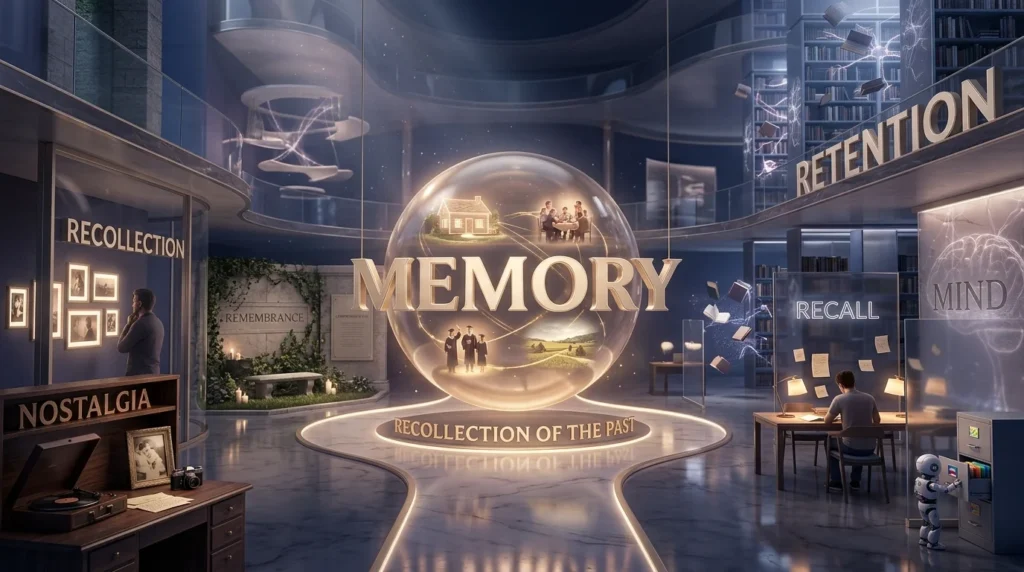
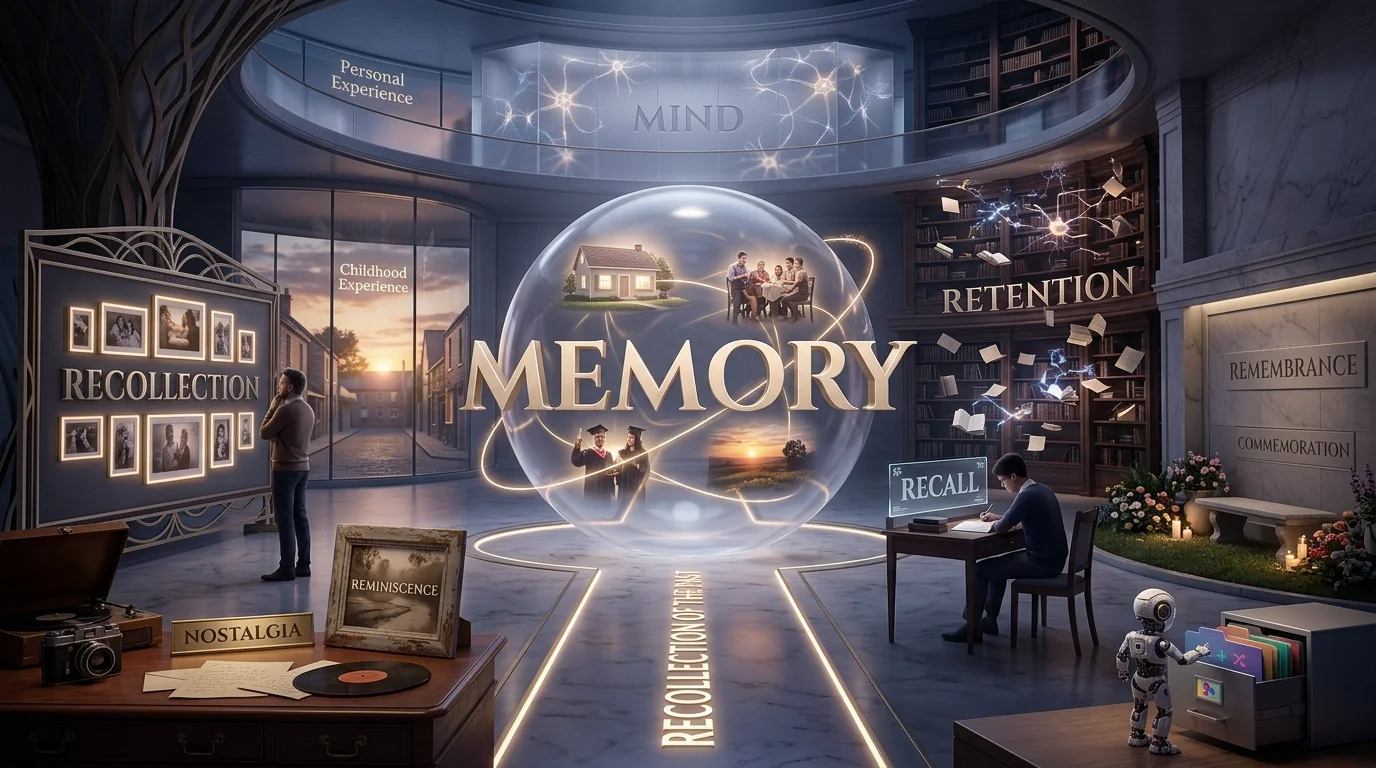
Quick List of Synonyms for Memory
Closest Synonyms
Recollection
Remembrance
Recall
Reminiscence
Retention
Remembering
Recalling
Recognition
Awareness
Mental record
Synonyms for Personal Memories
Flashback
Reflection
Recollection
Reminiscence
Impression
Experience
Past event
Mental image
Recalled experience
Personal history
Synonyms for Cherished Memories
Memento
Keepsake
Souvenir
Reminder
Tribute
Commemoration
Memorial
Remembrance
Synonyms for Memory Ability
Recall
Retention
Recognition
Mental capacity
Cognitive ability
Information retention
Learning retention
Mental storage
Note: These alternatives have different meanings. A keepsake is a physical object connected to a memory, while retention describes the ability to preserve information over time.
Best Synonyms for Memory and Their Meanings
1. Recollection
Meaning: Something remembered or the act of bringing a past experience to mind.
How it differs: Recollection often refers to a specific remembered event or detail.
Tone: Neutral or formal.
Best for: Personal experiences, conversations, and written accounts.
Example: Her recollection of the childhood trip was remarkably clear.
2. Remembrance
Meaning: The act of remembering someone or something, often with affection or respect.
How it differs: Remembrance frequently carries an emotional, commemorative, or respectful tone.
Tone: Warm, respectful, or formal.
Best for: Tributes, ceremonies, and personal writing.
Example: The family gathered in remembrance of their loved one.
3. Recall
Meaning: The ability or act of retrieving information from memory.
How it differs: Recall emphasizes bringing information back to mind rather than the memory itself.
Tone: Neutral or professional.
Best for: Education, psychology, testing, and everyday communication.
Example: Regular practice improved her recall of important facts.
4. Reminiscence
Meaning: The act of thinking or talking about past experiences, often with nostalgia.
How it differs: Reminiscence often involves reflecting on personal history rather than simply remembering a fact.
Tone: Reflective and nostalgic.
Best for: Personal essays, conversations, and memoirs.
Example: Their evening was filled with reminiscence about their school days.
5. Retention
Meaning: The ability to keep or preserve information in the mind.
How it differs: Retention focuses on maintaining information over time, not necessarily retrieving a particular event.
Tone: Professional or academic.
Best for: Learning, studying, and cognitive discussions.
Example: Short review sessions helped improve information retention.
6. Remembering
Meaning: The process of keeping something in mind or bringing it back to awareness.
How it differs: Remembering is the everyday term for the activity of memory.
Tone: Neutral and conversational.
Best for: Everyday writing and personal reflections.
Example: Remembering small details helped him tell the story accurately.
7. Recognition
Meaning: Identifying someone or something as familiar because it has been encountered before.
How it differs: Recognition differs from recall because a person may recognize an answer without being able to produce it independently.
Tone: Neutral or technical.
Best for: Learning, identification, and cognitive science.
Example: She had no trouble with recognition, even though recalling the names was difficult.
8. Flashback
Meaning: A vivid return to a past experience or scene in the mind.
How it differs: A flashback is more specific and often more vivid than an ordinary memory. It can also refer to a storytelling technique.
Tone: Descriptive or dramatic.
Best for: Fiction, film, and descriptions of vivid recollections.
Example: The photograph triggered a flashback to their first summer together.
9. Impression
Meaning: An idea, feeling, or image left in the mind by an experience.
How it differs: An impression may be incomplete or subjective rather than a detailed recollection.
Tone: Neutral.
Best for: Personal reflections and descriptions of past experiences.
Example: My strongest impression of the visit was the warmth of the local community.
10. Reflection
Meaning: Careful thought about past experiences, actions, or events.
How it differs: Reflection emphasizes thinking about an experience rather than simply remembering it.
Tone: Thoughtful and often formal.
Best for: Essays, journals, and personal development writing.
Example: A period of reflection helped her understand the lessons of that experience.
11. Keepsake
Meaning: An object kept because it reminds someone of a person, place, or event.
How it differs: A keepsake is a physical object associated with a memory, not the memory itself.
Tone: Warm and sentimental.
Best for: Gifts, family history, and personal stories.
Example: He kept the handwritten letter as a keepsake.
12. Memento
Meaning: An object that serves as a reminder of a person, place, or experience.
How it differs: Memento is close to keepsake, but it can sound slightly more formal.
Tone: Neutral or sentimental.
Best for: Travel, commemorations, and meaningful objects.
Example: She bought a small memento of her trip to the coast.
13. Souvenir
Meaning: An object purchased or kept to remind someone of a place or experience.
How it differs: Souvenir commonly refers to an item associated with travel or a particular event.
Tone: Neutral and conversational.
Best for: Travel writing and everyday descriptions.
Example: The postcard became a souvenir of their vacation.
14. Reminder
Meaning: Something that helps a person remember an event, fact, or person.
How it differs: A reminder can prompt a memory without preserving the memory itself.
Tone: Neutral.
Best for: Everyday communication and personal writing.
Example: The old song was a reminder of their friendship.
15. Memorial
Meaning: Something established to honor or remember a person or event.
How it differs: A memorial is usually a tribute or commemorative object, place, or event rather than an individual mental recollection.
Tone: Formal and respectful.
Best for: Historical writing and commemorations.
Example: The town built a memorial to honor those who had served.
16. Mental Image
Meaning: A picture or scene formed in the mind.
How it differs: A mental image focuses on the visual aspect of a memory and may not include every detail of the original event.
Tone: Neutral.
Best for: Creative writing and descriptions of remembered scenes.
Example: He still had a vivid mental image of the house where he grew up.
17. Mental Record
Meaning: Information or experiences retained in the mind.
How it differs: Mental record is a descriptive phrase rather than a direct, universally interchangeable synonym.
Tone: Neutral or technical.
Best for: Explanatory writing.
Example: Her mental record of the conversation helped her reconstruct what happened.
18. Personal History
Meaning: The collection of experiences and events that have shaped a person’s life.
How it differs: Personal history includes a broader life story, not just individual memories.
Tone: Neutral or reflective.
Best for: Biographies, memoirs, and personal essays.
Example: The journal preserved an important part of his personal history.
Synonyms for Memory by Context
| Context | Best alternative | Why it fits |
|---|---|---|
| Remembering a past event | Recollection | Focuses on a specific remembered experience |
| Honoring someone | Remembrance | Carries a respectful or emotional tone |
| Retrieving facts | Recall | Emphasizes bringing information to mind |
| Thinking about the past | Reminiscence | Often suggests nostalgia |
| Keeping information over time | Retention | Focuses on preserving knowledge |
| A vivid remembered scene | Flashback | Emphasizes a sudden or vivid return |
| A physical object linked to the past | Keepsake | Describes an item associated with a memory |
| A travel-related object | Souvenir | Connects an object to a place or trip |
| Reflecting on experiences | Reflection | Emphasizes thoughtful consideration |
| A public tribute | Memorial | Honors a person or event |
True Synonyms vs. Related Alternatives
| Alternative | Relationship | Can Replace Memory? | Tone | Best Context |
|---|---|---|---|---|
| Recollection | Close synonym | Usually, for a remembered event | Neutral | Personal experiences |
| Remembrance | Contextual synonym | Sometimes | Respectful | Tributes and honoring |
| Recall | Related concept | When referring to retrieval ability or action | Neutral | Learning and facts |
| Reminiscence | Contextual synonym | When reflecting on the past | Nostalgic | Personal stories |
| Retention | Related concept | When referring to keeping information | Technical | Education and psychology |
| Flashback | Specific type of recollection | Only for a vivid return to the past | Descriptive | Stories and vivid experiences |
| Impression | Related concept | Sometimes, for a general mental trace | Neutral | Personal reflections |
| Keepsake | Related object | No, not as a direct synonym | Sentimental | Personal possessions |
| Souvenir | Related object | No, not as a direct synonym | Casual | Travel |
| Memorial | Related concept | No, not as a direct synonym | Respectful | Commemoration |
Memory vs. Recollection vs. Remembrance
Memory vs. recollection: Memory is the broader term for the ability to remember and for something remembered. Recollection usually emphasizes a particular event or detail brought back to mind.
Memory vs. remembrance: Remembrance often adds affection, respect, or commemoration. It is common when honoring someone who has died or recalling a meaningful experience.
Memory vs. recall: Memory can refer to stored information or the mental ability itself. Recall focuses on retrieving that information.
Memory vs. retention: Retention describes keeping information over time, while memory can refer to the entire process or the remembered content.
Sentence Transformations Using Synonyms for Memory
Example 1: A Childhood Memory
Original: I have a beautiful memory of my childhood.
Better Alternative: I have a beautiful recollection of my childhood.
Why: Recollection emphasizes the experience being remembered.
Example 2: Honoring a Loved One
Original: The gathering was held in memory of her grandfather.
Better Alternative: The gathering was held in remembrance of her grandfather.
Why: Remembrance sounds natural in a respectful or commemorative context.
Example 3: Remembering Information
Original: His memory of the facts improved after practice.
Better Alternative: His recall of the facts improved after practice.
Why: Recall emphasizes the ability to retrieve information.
Example 4: Looking Back
Original: She shared memories of her school years.
Better Alternative: She shared reminiscences of her school years.
Why: Reminiscences emphasizes stories and reflections about the past.
Example 5: Learning New Information
Original: The student struggled with memory retention.
Better Alternative: The student struggled to retain information.
Why: The revised sentence uses the verb retain naturally and makes the meaning clear.
Example 6: A Vivid Past Experience
Original: The sound brought back a painful memory.
Better Alternative: The sound triggered a painful flashback.
Why: Flashback suggests a vivid return to a past scene or experience, which is a stronger and more specific meaning.
Example 7: A Special Object
Original: She kept the ticket as a memory of the concert.
Better Alternative: She kept the ticket as a keepsake from the concert.
Why: Keepsake accurately describes a physical object preserved for sentimental reasons.
Example 8: A Travel Object
Original: He bought a memory of his trip.
Better Alternative: He bought a souvenir of his trip.
Why: Souvenir is the natural word for an object kept to remember a place or experience.
Example 9: Thinking About the Past
Original: His memory of those events helped him understand his choices.
Better Alternative: Reflection on those events helped him understand his choices.
Why: Reflection emphasizes careful thought about past experiences rather than simple recall.

Common Mistakes When Choosing a Synonym for Memory
Using recall for every meaning of memory. Recall emphasizes retrieving information, while memory can refer to the information itself or the mental ability.
Confusing remembrance with recollection. Remembrance often suggests honoring or remembering someone; recollection usually refers to a specific remembered event.
Calling a keepsake a memory. A keepsake is a physical object that reminds someone of the past.
Using flashback for an ordinary memory. A flashback suggests a vivid or sudden return to a past scene and may carry specific meanings in psychological contexts.
Confusing retention with recall. Retention concerns keeping information; recall concerns retrieving it.
Using reminiscence for a simple fact. Reminiscence is more natural for reflecting on or talking about past experiences.
Using memorial as a direct replacement for memory. A memorial is something created or established to honor a person or event.
Treating recognition and recall as identical. Recognition means identifying something as familiar; recall means retrieving information without necessarily being shown it.
Commonly Confused Words
Memory vs. Memorization
Memory is the mental ability to retain and recall information. Memorization is the process of learning something so that it can be remembered.
Her memory for names is excellent.
Memorization helped him prepare for the test.
Memory vs. Reminiscence
Memory can refer to any remembered information or experience. Reminiscence usually involves thinking or talking about the past, often with nostalgia.
I have a clear memory of the event.
Their conversation turned into a reminiscence about childhood.
Memory vs. Reminder
A memory is something remembered. A reminder is something that prompts a person to remember.
The photograph brought back a memory.
The photograph served as a reminder of their friendship.
Memory vs. Keepsake
A memory exists in the mind. A keepsake is a physical item preserved because it has personal meaning.
She remembered the trip fondly.
She kept a seashell as a keepsake from the trip.
Grammar and Usage Tips
Memory of: Use this construction for a remembered person, event, or experience: “I have a clear memory of that day.”
Memory for: Use it to describe the ability to remember a category of information: “She has an excellent memory for faces.”
In memory of: Use this expression to honor someone who has died: “The scholarship was established in memory of the teacher.”
Bring back memories: Use this common phrase when something causes past experiences to come to mind.
Commit to memory: This means to learn or remember something carefully.
Memories vs. memory: Use memories for multiple remembered experiences. Use memory when discussing the general ability or an uncountable concept.
When Not to Replace Memory
Keep memory when you are discussing the general ability to remember, stored information, or a broad range of past experiences. It is often more natural than a specialized alternative.
Avoid recollection when you mean the overall mental ability, retention when you mean a specific remembered event, and remembrance when you simply mean retrieving a fact. Do not use keepsake, souvenir, or memorial as direct synonyms for mental memory because they describe physical objects or commemorative items.
Choose the word that matches your intended meaning rather than replacing memory just to avoid repetition.
Writing Tips: How to Use Memory Synonyms Naturally
Use recollection when discussing a specific event or detail.
Choose remembrance for respectful or emotional references to someone or something.
Use recall when discussing the retrieval of facts or information.
Choose retention when discussing how well information is preserved over time.
Use reminiscence when describing nostalgic conversations or reflections.
Choose keepsake or souvenir when referring to a physical object connected to the past.
Repeat memory when it is the clearest word for your meaning.