
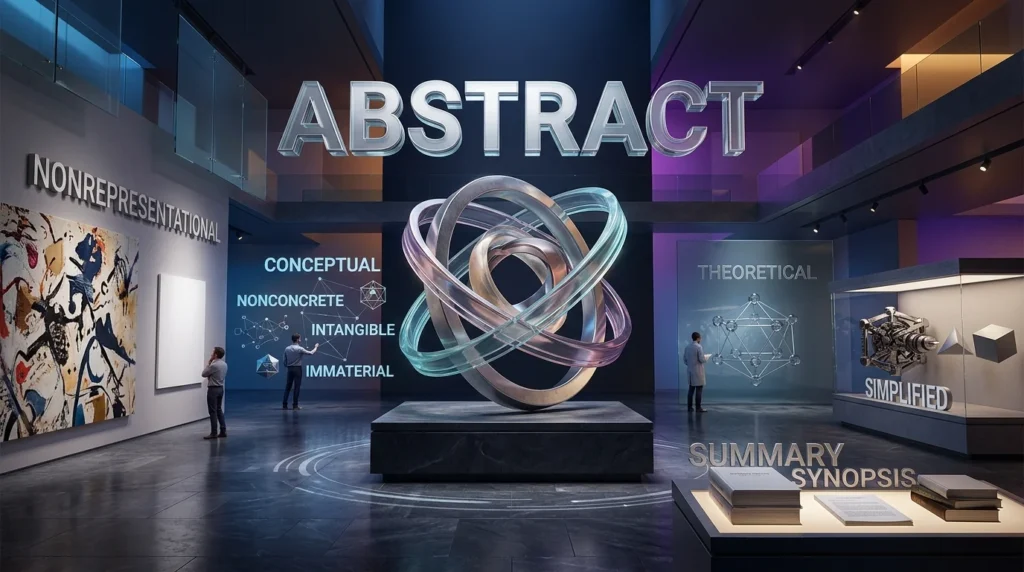

List of Synonyms for Abstract
Here are useful alternatives to abstract, grouped by meaning and usage.
Synonyms Meaning Theoretical or Conceptual
Conceptual
Theoretical
Philosophical
Intellectual
Hypothetical
Speculative
Ideational
Generalized
Analytical
Academic
Rational
Abstracted
Idealized
Notional
Nonconcrete
Synonyms Meaning Intangible or Nonphysical
Intangible
Immaterial
Nonphysical
Incorporeal
Insensible
Imperceptible
Spiritual
Ideal
Nonmaterial
Unobservable
Synonyms Related to Abstract Art
Nonrepresentational
Nonfigurative
Geometric
Experimental
Stylized
Symbolic
Expressive
Nonliteral
Interpretive
Modernist
Note: These terms describe different artistic approaches and are not exact synonyms in every situation.
Synonyms Meaning a Summary or Brief Overview
Summary
Synopsis
Overview
Outline
Digest
Brief
Recap
Condensation
Précis
Epitome
When abstract is used as a noun in academic writing, summary or overview may be the most appropriate replacement.
Best Synonyms for Abstract by Meaning
1. Synonyms for Abstract Ideas
When abstract describes ideas, concepts, or thinking that is not tied to a specific physical object, these alternatives are useful.
Conceptual: Related to ideas or mental concepts.
Theoretical: Based on principles or explanations rather than direct practical application.
Philosophical: Concerned with fundamental questions about knowledge, existence, or values.
Intellectual: Connected with reasoning, thought, or understanding.
Hypothetical: Based on a situation imagined for discussion or analysis.
Speculative: Based on possibilities or assumptions rather than established facts.
Notional: Existing as an idea or concept rather than as a physical reality.
Idealized: Represented in a simplified or perfected form.
Example: The professor explained an abstract concept during the lecture.
Alternative: The professor explained a theoretical concept during the lecture.
Conceptual may be more natural when the focus is on an idea itself, while theoretical emphasizes principles or explanations.
2. Synonyms for Abstract Things That Cannot Be Touched
When abstract means nonphysical, these words can communicate that meaning more precisely.
Intangible: Not physically touchable, often referring to qualities, benefits, or assets.
Immaterial: Not physical or not consisting of matter; it can also mean unimportant in certain contexts.
Nonphysical: Not relating to a physical object or substance.
Incorporeal: Having no physical body; a more formal or literary term.
Imperceptible: Too subtle or slight to be noticed by the senses.
Nonmaterial: Not consisting of physical matter.
Spiritual: Relating to the spirit or matters beyond the physical world.
Example: Trust is an abstract quality that supports strong relationships.
Alternative: Trust is an intangible quality that supports strong relationships.
Intangible is especially useful for qualities such as trust, reputation, goodwill, and emotional value.
3. Synonyms for Abstract Art
In art, abstract commonly describes work that does not represent objects or scenes in a straightforward, realistic way.
Nonrepresentational: Not depicting recognizable objects or scenes.
Nonfigurative: Not representing recognizable figures or forms.
Geometric: Using shapes such as circles, squares, and triangles.
Experimental: Exploring unconventional methods or forms.
Stylized: Presenting subjects in a distinctive or simplified manner.
Expressive: Emphasizing emotion, mood, or personal expression.
Symbolic: Using images or forms to represent deeper meanings.
Nonliteral: Not intended to represent something in a strictly literal way.
Example: The gallery displayed an abstract painting filled with bold colors and unusual shapes.
Alternative: The gallery displayed a nonrepresentational painting filled with bold colors and unusual shapes.
Not every abstract artwork is geometric or symbolic, so choose a term that describes the actual style.
4. Synonyms for an Abstract in Academic Writing
In research papers, an abstract is a short section summarizing the study’s purpose, methods, results, and conclusions.
Summary: A concise statement of the main points.
Synopsis: A brief account of the essential content.
Overview: A general description of a subject or document.
Digest: A condensed presentation of important information.
Brief: A short account or explanation.
Précis: A concise and carefully organized summary.
Outline: A structured list of the main points.
Condensation: A shortened version of a longer text.
Example: Read the abstract before reviewing the full research paper.
Alternative: Read the summary before reviewing the full research paper.
In formal academic settings, abstract is the standard term for this specific section. A summary may serve a similar purpose but does not always follow the same conventions.

Abstract Synonyms by Context
Abstract in Academic Writing
Useful alternatives include:
Theoretical
Conceptual
Analytical
Hypothetical
Philosophical
Generalized
Example: The article examines abstract principles of economic behavior.
Alternative: The article examines theoretical principles of economic behavior.
Abstract in Business and Strategy
Useful alternatives include:
Conceptual
High-level
Theoretical
Generalized
Intangible
Nonconcrete
Example: The manager presented an abstract plan without specific implementation steps.
Alternative: The manager presented a high-level plan without specific implementation steps.
High-level can be a good alternative when abstract means broad or lacking practical detail, although the words do not mean exactly the same thing.
Abstract in Philosophy
Useful alternatives include:
Conceptual
Theoretical
Intellectual
Metaphysical
Philosophical
Speculative
Example: The discussion focused on abstract questions about reality.
Alternative: The discussion focused on philosophical questions about reality.
Abstract in Art and Design
Useful alternatives include:
Nonrepresentational
Nonfigurative
Geometric
Experimental
Expressive
Stylized
Example: The designer created an abstract pattern for the cover.
Alternative: The designer created a geometric pattern for the cover.
Use geometric only when the design actually emphasizes geometric shapes.
Abstract vs. Similar Words: What’s the Difference?
| Word | Main meaning | Best use |
|---|---|---|
| Conceptual | Relating to ideas | Plans, models, and concepts |
| Theoretical | Based on principles or theory | Research and explanations |
| Intangible | Not physically touchable | Qualities, benefits, and assets |
| Hypothetical | Imagined for discussion | Examples and possible scenarios |
| Speculative | Based on uncertain possibilities | Predictions and interpretations |
| Philosophical | Concerned with fundamental questions | Ethics, existence, and knowledge |
| Nonrepresentational | Not depicting recognizable subjects | Art and visual design |
| Summary | A brief account of main points | Documents and research papers |
| Synopsis | A concise outline of content | Books, reports, and presentations |
| High-level | Broad rather than detailed | Business plans and overviews |
Examples of Abstract Synonyms in Sentences
Here are eight examples showing how to replace abstract with a more precise alternative.
Original: The students struggled to understand the abstract theory.
Revised: The students struggled to understand the theoretical framework.Original: Love is an abstract concept.
Revised: Love is an intangible concept.Original: The researcher included an abstract at the beginning of the paper.
Revised: The researcher included a summary at the beginning of the paper.Original: The artist created an abstract composition.
Revised: The artist created a nonrepresentational composition.Original: The discussion involved abstract questions about morality.
Revised: The discussion involved philosophical questions about morality.Original: The proposal was too abstract to guide the team.
Revised: The proposal was too vague to guide the team.Original: The report explored an abstract possibility.
Revised: The report explored a hypothetical possibility.Original: The company recognized the abstract value of its reputation.
Revised: The company recognized the intangible value of its reputation.
Common Mistakes When Using Abstract Synonyms
Treating abstract and theoretical as identical: Theoretical usually relates to principles or explanations, while abstract can also mean nonphysical or nonrepresentational.
Using intangible for every abstract idea: Intangible emphasizes the absence of physical form; it may not fit an abstract mathematical argument.
Confusing hypothetical with speculative: A hypothetical situation is imagined for analysis, while speculation involves uncertain assumptions or possibilities.
Replacing every academic abstract with a synopsis: A synopsis may summarize a work broadly, but an academic abstract typically follows specific conventions.
Using geometric as a synonym for all abstract art: Abstract art can include organic forms, expressive marks, and many other approaches.
Confusing vague with abstract: An abstract idea can be clearly explained, while a vague idea lacks clarity or detail.
Using philosophical for every theoretical concept: Philosophy is one particular field of thought, not a general substitute for all theory.
Using immaterial without checking its meaning: It can mean nonphysical, but it can also mean irrelevant or unimportant.
How to Choose the Best Synonym for Abstract
Ask yourself what abstract means in your sentence:
An idea or concept: Use conceptual or theoretical.
Something nonphysical: Use intangible or nonphysical.
An imagined situation: Use hypothetical.
An uncertain interpretation: Use speculative.
A broad plan without details: Use high-level or generalized.
A nonrepresentational artwork: Use nonrepresentational or nonfigurative.
A short research-paper section: Use summary when a less specialized term is appropriate.
An unclear explanation: Use vague if the real issue is a lack of clarity.