

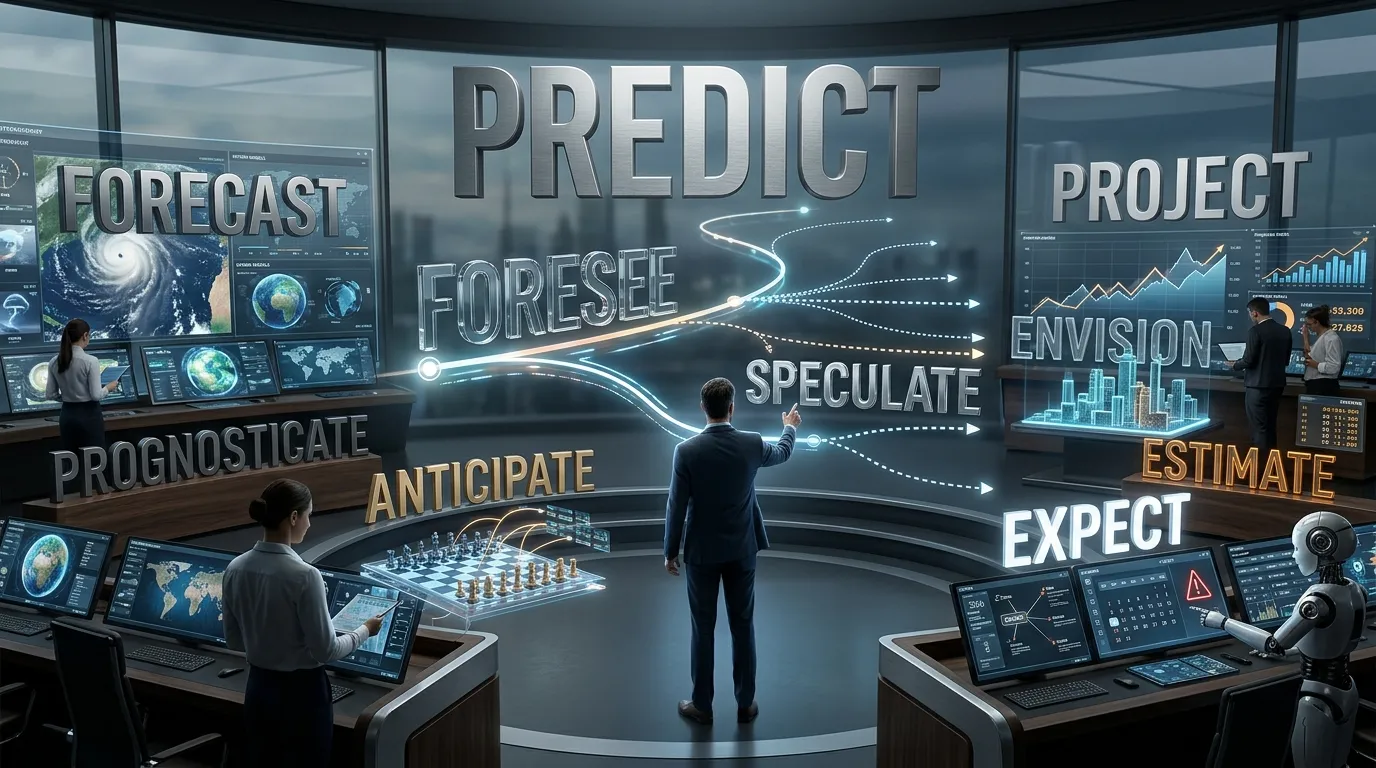
45+ Synonyms for Predict
1. Common Synonyms for Predict
These alternatives work in everyday conversations and general writing when discussing what may happen.
Forecast — to say what is likely to happen based on information or trends.
Anticipate — to expect something before it happens.
Foresee — to imagine or recognize a future event in advance.
Expect — to believe that something will probably happen.
Envision — to imagine a possible future situation.
Project — to estimate a future result using current information.
Estimate — to calculate or judge an approximate amount or outcome.
Speculate — to form an opinion about something uncertain.
Foretell — to say what will happen in the future.
Presage — to indicate or suggest that something may happen.
Example: Experts forecast that demand for electric vehicles will continue to grow.
2. Synonyms for Predict Based on Evidence
Use these words when a prediction comes from facts, data, experience, or careful analysis.
Project — to calculate a likely future result from current figures.
Extrapolate — to estimate future values by extending known trends.
Calculate — to determine a result mathematically.
Estimate — to judge an approximate value or outcome.
Infer — to reach a conclusion from available evidence.
Deduce — to reach a conclusion through logical reasoning.
Analyze — to examine information to understand likely outcomes.
Model — to represent a situation mathematically or conceptually to explore possible outcomes.
Gauge — to judge the likely extent or nature of something.
Assess — to evaluate information before making a judgment.
Determine — to establish something through reasoning or evidence, though it does not always mean predicting.
Calculate in advance — to work out an expected result before an event occurs.
Example: Researchers extrapolated future sales from the company’s recent growth.
3. Synonyms for Predict an Event or Outcome
These alternatives are useful when discussing what someone believes will happen.
Foresee — to recognize a possible future event.
Anticipate — to expect an event or prepare for it.
Expect — to consider an event likely.
Envisage — to imagine or consider a possible future situation.
Project — to estimate a future result.
Call — informal; to make a prediction, especially about a result or winner.
Presume — to accept something as likely without complete proof.
Suppose — to think something may be true or happen.
Conjecture — to form an opinion without sufficient evidence.
Hypothesize — to propose an explanation or possibility that can be examined.
Surmise — to reach a conclusion based on limited evidence.
Prognosticate — to predict a future event, often in a formal or specialized context.
Example: Few people foresaw how quickly the technology would change the industry.
4. Synonyms for Predict the Future
These words emphasize future events, long-term developments, or claims about what lies ahead.
Foretell — to tell or state what will happen.
Prophesy — to predict something, often in a religious or spiritual context.
Prognosticate — to predict a future development, often formally.
Divine — to discover or predict something through intuition or mysterious insight.
Discern — to recognize or detect a possibility, pattern, or development.
Envision — to imagine a future possibility.
Anticipate — to expect something in advance.
Foreknow — to know about something before it happens.
Read the signs — to interpret clues that suggest a future outcome.
See coming — an informal expression meaning to recognize that something is likely to happen.
Example: The analyst foresaw major changes in the housing market.
Note: Words such as prophesy and divine may imply spiritual insight or intuition, so they are not neutral replacements in every context.
5. Informal Alternatives to Predict
These expressions work well in casual conversation and less formal writing.
Guess — to give an answer without knowing for certain.
Bet — informal; to feel confident that something will happen.
Call it — to make a prediction or decision about an outcome.
Take a guess — to offer a possible answer without enough information.
Figure — informal; to think or expect that something is likely.
See coming — to recognize an event before it happens.
Take a shot — to make an attempt or guess, often with uncertainty.
Make an educated guess — to estimate an answer using available knowledge.
Hazard a guess — to offer a guess despite uncertainty.
Put money on — informal; to express strong confidence in an outcome.
Example: I bet the home team will win tonight.

Synonyms for Predict by Context
| Context | Best alternatives | Example |
|---|---|---|
| Weather | Forecast, project | Meteorologists forecast heavy rain. |
| Business and finance | Project, estimate, forecast | The company projected higher revenue. |
| Everyday expectations | Expect, anticipate | We anticipate a busy weekend. |
| Scientific analysis | Extrapolate, model, estimate | Researchers modeled future temperatures. |
| Personal judgment | Guess, surmise, speculate | I guessed the ending of the story. |
| Future possibilities | Envision, foresee, envisage | She envisioned a different future. |
| Religious or spiritual claims | Prophesy, foretell | The text was believed to foretell a major event. |
| Sports and competitions | Call, pick, predict | He called the winner correctly. |
Predict vs. Similar Words: What’s the Difference?
Not every related word communicates the same level of certainty or method.
| Word | Meaning | Best use |
|---|---|---|
| Predict | To state what may happen in the future | General predictions |
| Forecast | To estimate a future event using information or trends | Weather, business, and economic trends |
| Anticipate | To expect something and often prepare for it | Expected events or needs |
| Foresee | To recognize a possible future event in advance | Consequences, risks, and changes |
| Estimate | To judge an approximate amount or outcome | Costs, quantities, and likely results |
| Project | To calculate or suggest a future result from current data | Financial and statistical planning |
| Speculate | To consider possibilities without firm evidence | Uncertain situations |
| Prophesy | To predict, often with a religious or spiritual association | Religious or literary contexts |
| Guess | To offer an answer with limited information | Casual conversations |
| Extrapolate | To extend an existing trend to estimate future values | Data analysis and research |
Key distinction: A forecast often relies on data, while a guess may involve little evidence. To anticipate something can also mean preparing for it, whereas predicting usually focuses on saying what is likely to happen.
Sentence Examples: How to Replace Predict
Here are 10 examples showing how to use alternatives naturally.
Original: Experts predict that prices will rise.
Alternative: Experts forecast that prices will rise.Original: She predicted that the project would fail.
Alternative: She foresaw that the project might fail.Original: Analysts predict a rise in company profits.
Alternative: Analysts project a rise in company profits.Original: We predict heavy traffic during the holiday.
Alternative: We anticipate heavy traffic during the holiday.Original: It is difficult to predict the final cost.
Alternative: It is difficult to estimate the final cost.Original: No one predicted the sudden change.
Alternative: No one saw the change coming.Original: The scientist predicted future temperature changes using the data.
Alternative: The scientist extrapolated future temperature changes from the data.Original: He predicted that his team would win.
Alternative: He called his team’s victory.Original: The author predicted a major social change.
Alternative: The author envisioned a major social change.Original: They predicted that the plan would succeed.
Alternative: They expected the plan to succeed.
Common Mistakes When Using Synonyms for Predict
Using forecast for every prediction. Forecast is especially common for weather, trends, and outcomes based on evidence.
Confusing anticipate with predict. Anticipate can include preparing for an event, not just saying it will happen.
Using estimate when exact prediction is implied. An estimate usually communicates an approximate value or outcome.
Treating speculate as a confident prediction. Speculation often signals uncertainty or limited evidence.
Using prophesy in neutral business writing. It can carry religious or mystical associations.
Confusing infer with predict. To infer is to draw a conclusion from evidence; that conclusion does not have to concern the future.
Using extrapolate without a trend or data. Extrapolation generally extends known information to estimate an unknown value.
Assuming foresee means knowing the future with certainty. It means recognizing a possible event in advance, not having guaranteed knowledge.
How to Choose the Best Synonym for Predict
Use this quick guide when editing your writing:
Choose forecast for weather, economic trends, and data-based outlooks.
Choose anticipate when you expect an event or prepare for it.
Choose foresee when describing an ability to recognize future consequences.
Choose estimate for approximate amounts, costs, or results.
Choose project for calculated future outcomes, especially in business.
Choose speculate when evidence is incomplete and the outcome remains uncertain.
Choose guess for an informal prediction with limited information.
Choose extrapolate when extending an existing data trend.
Choose prophesy for religious, spiritual, or literary contexts.
Choose envision when describing a future possibility you imagine.