
1. Common Synonyms for Blurry
These alternatives work in many everyday situations, although their meanings are not always identical.
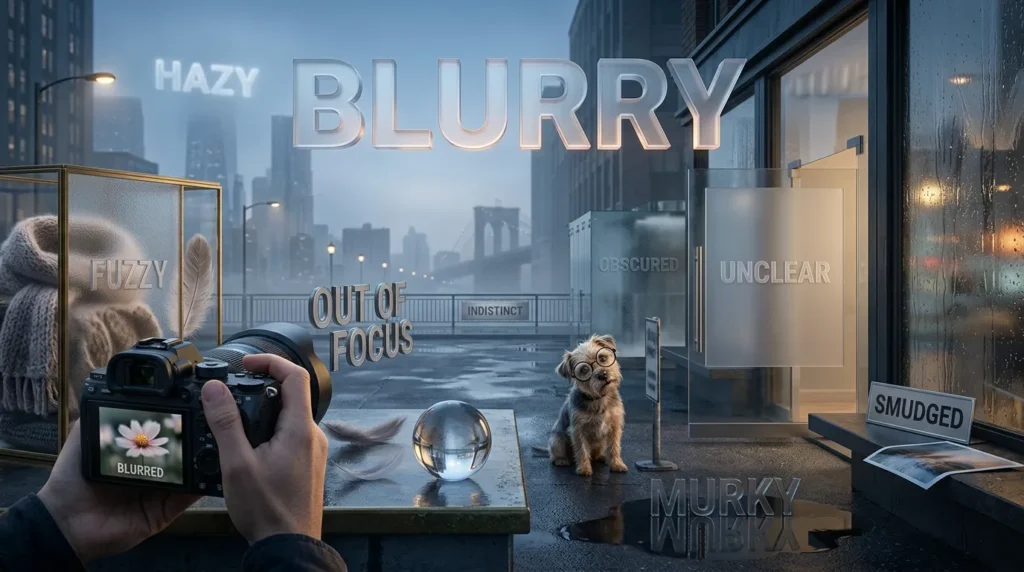
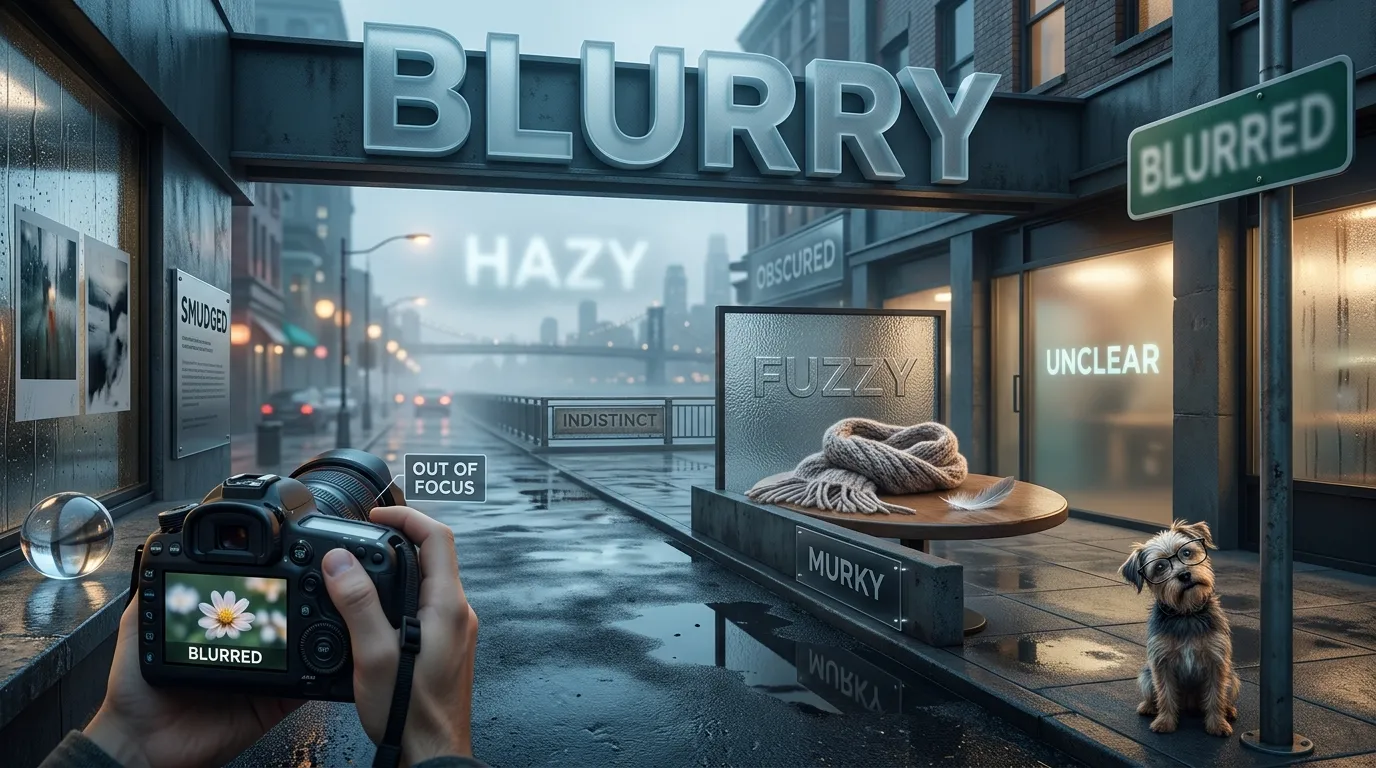
Fuzzy: Lacking sharp edges or clear details.
Example: The old photograph looks fuzzy.Unclear: Difficult to see, understand, or interpret.
Example: The instructions were unclear.Hazy: Difficult to see because of mist, smoke, heat, or a lack of clarity.
Example: The mountains looked hazy in the distance.Indistinct: Not clearly visible, recognizable, or defined.
Example: We could make out an indistinct figure across the street.Unfocused: Not adjusted to produce a sharp image; also used for attention that wanders.
Example: The camera produced an unfocused image.Out of focus: Not sharply focused by a camera or the eye.
Example: The subject in the photograph is out of focus.Foggy: Covered by fog or difficult to see through; sometimes used for unclear thinking.
Example: The windshield looked foggy.Vague: Not expressed or remembered clearly.
Example: I have a vague memory of that conversation.Indefinite: Not clearly defined, fixed, or specific.
Example: The image showed an indefinite shape.Soft: Having edges or details that are not sharply defined.
Example: The portrait has a soft, slightly blurry background.
2. Synonyms for Blurry Images and Photographs
When describing a photograph, video, screen, or digital image, choose words that explain the specific visual problem.
| Synonym | Meaning | Example |
|---|---|---|
| Out of focus | The subject is not sharply focused | The portrait is out of focus. |
| Fuzzy | Details look soft or unclear | The scanned photo is fuzzy. |
| Pixelated | Individual pixels are visible | The enlarged image looks pixelated. |
| Low-resolution | The image contains limited detail | The logo looks low-resolution on the screen. |
| Blurred | Details appear smeared or lack sharpness | The moving car appears blurred. |
| Soft-focused | The image has intentionally softened details | The photographer used a soft-focused effect. |
| Distorted | The image’s shape or appearance is altered | The reflection looks distorted. |
| Smudged | Marks or colors appear rubbed or smeared | The camera lens made the picture look smudged. |
| Grainy | The image contains visible grain or noise | The nighttime photo looks grainy. |
| Indistinct | The subject is difficult to identify | An indistinct figure appears in the background. |
Important distinction: Pixelated, grainy, and distorted do not mean exactly the same thing as blurry. Pixelation involves visible blocks of pixels, graininess involves visual noise, and distortion involves changes in shape or appearance.
3. Synonyms for Blurry Vision
When discussing eyesight, use terms that describe the visual experience accurately.
Unclear vision: Vision that lacks clarity.
Example: The text appeared unclear.Hazy vision: A fog-like or clouded visual appearance.
Example: The room looked hazy to her.Fuzzy vision: A casual expression for vision without sharp details.
Example: The letters looked fuzzy from a distance.Out-of-focus vision: A description of objects that do not appear sharply defined.
Example: The nearby sign seemed out of focus.Clouded vision: Vision that seems obscured or clouded.
Example: His vision felt clouded.Indistinct vision: Vision in which shapes or details are difficult to distinguish.
Example: The distant figures appeared indistinct.
Health note: Sudden blurry vision, especially with eye pain, severe headache, weakness, or loss of vision, may require urgent medical attention. A synonym describes the symptom but does not explain its cause.
4. Synonyms for Blurry Ideas, Memories, and Explanations
When blurry is used figuratively, words about uncertainty or a lack of detail are often more natural.
Vague: Lacking specific information.
Example: She gave a vague description of the event.Unclear: Difficult to understand.
Example: His explanation was unclear.Fuzzy: Informal; not fully formed or precise.
Example: We have a fuzzy idea of how the project will work.Imprecise: Not exact or accurate enough.
Example: The report used imprecise language.Ambiguous: Open to more than one interpretation.
Example: The message was ambiguous.Confused: Lacking logical order or clear understanding.
Example: The argument became confused.Indistinct: Not clearly remembered or mentally defined.
Example: My earliest memories are indistinct.Uncertain: Not known or established with confidence.
Example: The details of the incident remain uncertain.Muddled: Confused or poorly organized.
Example: The explanation was muddled.Ill-defined: Not clearly described or established.
Example: The plan had ill-defined goals.
5. More Alternatives to Blurry
These words can be useful in specific contexts, but they are not interchangeable in every sentence.
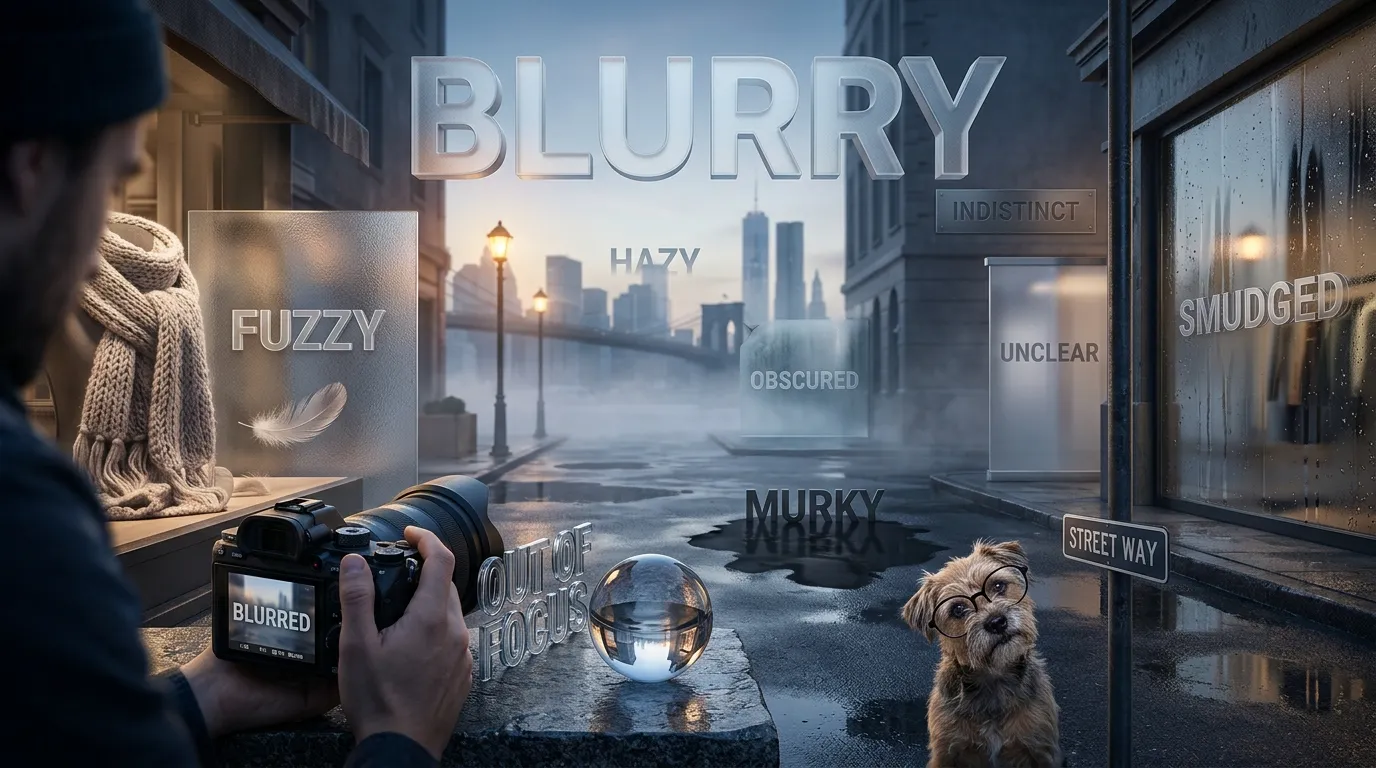
Smudged: Marked by something rubbed or smeared.
Smeared: Spread or dragged across a surface.
Mist-covered: Covered with mist.
Obscured: Hidden or made difficult to see.
Cloudy: Not transparent or visually clear.
Dim: Lacking brightness.
Shadowy: Dark or partly hidden in shadow.
Faint: Weak, pale, or barely noticeable.
Indeterminate: Not clearly established or identifiable.
Unfocused: Lacking sharpness or concentrated attention.
Imprecise: Lacking exactness.
Ambiguous: Having multiple possible meanings.
Uncertain: Not definite or confidently known.
Misty: Filled with or resembling mist.
Hazy: Lacking visual or mental clarity.
Soft-edged: Having edges that are not sharply defined.
Poorly defined: Lacking clear boundaries or details.
Hard to distinguish: Difficult to tell apart.
Out of alignment: Not positioned correctly; appropriate only when alignment is the actual problem.
Unrecognizable: So unclear or altered that identification is difficult or impossible.
6. Blurry vs. Similar Words: What’s the Difference?
| Word | Main meaning | Best use |
|---|---|---|
| Blurry | Lacking sharp visual detail | Blurry photograph |
| Fuzzy | Soft or unclear in appearance | Fuzzy image |
| Hazy | Misty or lacking clarity | Hazy landscape |
| Vague | Lacking specific details | Vague memory |
| Indistinct | Difficult to recognize or distinguish | Indistinct shape |
| Pixelated | Showing visible pixel blocks | Pixelated graphic |
| Grainy | Showing visible grain or image noise | Grainy photograph |
| Distorted | Changed in shape or appearance | Distorted image |
| Smudged | Rubbed or smeared | Smudged writing |
| Ambiguous | Open to multiple interpretations | Ambiguous statement |
7. Sentence Transformations Using Synonyms for Blurry
Here are 10 examples showing how to replace blurry with a more precise alternative.
Original: The photograph is blurry.
Improved: The photograph is out of focus.Original: The distant buildings look blurry.
Improved: The distant buildings look hazy.Original: The image on my screen is blurry.
Improved: The image on my screen is pixelated.
Use this only if visible pixels are the problem.Original: I have a blurry memory of the trip.
Improved: I have a vague memory of the trip.Original: His explanation was blurry.
Improved: His explanation was unclear.Original: The figure in the distance was blurry.
Improved: The figure in the distance was indistinct.Original: The writing looks blurry because the ink spread.
Improved: The writing looks smudged.Original: The photo taken at night is blurry and rough-looking.
Improved: The photo taken at night is grainy.
Use this when visible noise is the main issue.Original: The plan’s purpose is blurry.
Improved: The plan’s purpose is ill-defined.Original: The image looks blurry because its shape has changed.
Improved: The image looks distorted.
8. Common Mistakes When Using Synonyms for Blurry
Using vague for every blurry photograph: Vague usually describes ideas, statements, or memories rather than a camera’s focus.
Treating pixelated as an exact synonym: Pixelation refers to visible pixel blocks, not every type of image blur.
Confusing grainy with out of focus: Graininess comes from visible image noise, while being out of focus means the subject lacks sharpness.
Using ambiguous for an unclear picture: Ambiguous usually means something has more than one possible meaning or interpretation.
Using dim to mean blurry: Dim describes a lack of light or brightness. A dim image can still be sharp.
Confusing smudged with distorted: Smudging involves rubbing or spreading marks; distortion changes shape or appearance.
Using indistinct when you mean invisible: Something indistinct can still be seen, even if its details are difficult to recognize.
Calling every unclear explanation blurry: In formal writing, unclear, imprecise, or ambiguous is usually more natural.
Using cloudy for every vision problem: Cloudy vision describes a particular hazy or clouded experience and does not identify its cause.
Replacing words without checking context: A synonym should preserve the original sentence’s meaning, tone, and grammar.
9. How to Choose the Best Synonym for Blurry
Use this quick guide to find the most accurate word.
For photographs: Choose out of focus, fuzzy, or blurred.
For visible pixel blocks: Choose pixelated.
For images with visible noise: Choose grainy.
For distant scenery: Choose hazy or indistinct.
For unclear writing or instructions: Choose unclear or ambiguous, depending on the problem.
For unclear memories: Choose vague or indistinct.
For smeared ink or marks: Choose smudged or smeared.
For unclear plans or goals: Choose ill-defined or imprecise.
For objects hidden from view: Choose obscured.
For vision symptoms: Describe the experience as blurry, hazy, or clouded, without assuming a medical cause.