


Quick Synonym List
Note as a written message
Message
Memo
Memorandum
Reminder
Letter
Communication
Notice
Card
Brief
Statement
Note as an observation or comment
Remark
Comment
Observation
Point
Mention
Statement
Reflection
Thought
Detail
Consideration
Note as a record
Record
Entry
Annotation
Documentation
Log
Account
Citation
Notation
Recordkeeping entry
Note as a verb
Notice
Observe
Mention
Record
Document
Recognize
Identify
Acknowledge
Point out
Remark
Register
Detect
Note in music
Tone
Pitch
Sound
Musical tone
Musical symbol
Notation
Note meaning paper money
Banknote
Bill
Currency
Denomination
Paper money
What Does Note Mean?
Note is both a noun and a verb with several distinct meanings.
As a noun, it can refer to:
A short written message
A reminder
An observation or comment
A written record
A musical sound or symbol
A banknote or piece of paper currency
As a verb, it can mean:
To notice or observe something
To mention something
To write something down
To recognize or acknowledge something
Because these meanings are different, there is no single synonym that works everywhere.
Synonyms for Note Meaning a Written Message
1. Message
Message is a broad alternative for a short piece of communication.
I left a note on the kitchen table.
I left a message on the kitchen table.
Best for: Everyday communication.
Difference: Message can be spoken, digital, or written, while note often suggests a short written communication.
2. Memo
A memo is a short written communication, especially in a workplace or organization.
The manager sent a memo about the new schedule.
Best for: Business and workplace communication.
Difference: A memo is usually more formal and organizational than an ordinary note.
3. Memorandum
Memorandum is the formal, expanded form of memo.
The department issued a memorandum outlining the policy changes.
Best for: Formal business, government, academic, or organizational communication.
4. Reminder
A reminder is a message intended to help someone remember something.
She left me a reminder about the appointment.
Best for: Deadlines, appointments, tasks, and events.
Difference: A reminder has a specific purpose: helping someone remember.
5. Letter
A letter is a written communication, usually longer and more structured than a note.
He sent a note thanking her for the gift.
He sent a letter thanking her for the gift.
Difference: Letter generally suggests a more developed written communication.
Synonyms for Note Meaning an Observation or Comment
6. Remark
A remark is something said or written as a comment or observation.
She made a note about the unusual results.
She made a remark about the unusual results.
Best for: Comments, observations, conversations, and writing.
7. Comment
A comment expresses an opinion, observation, or response.
He added a note about the final paragraph.
He added a comment about the final paragraph.
Best for: Discussions, reviews, essays, online communication, and feedback.
8. Observation
An observation is something noticed or stated after paying attention to a situation.
Her note about the patient’s behavior was useful.
Her observation about the patient’s behavior was useful.
Best for: Academic, scientific, professional, and analytical writing.
9. Point
Point can refer to an idea or detail that someone wants to emphasize.
She raised an important point during the meeting.
Best for: Discussions, presentations, arguments, and explanations.
10. Mention
A mention is a brief reference to someone or something.
He made a note of the problem during the presentation.
He made a mention of the problem during the presentation.
Best for: Brief references.
Difference: Mention focuses on bringing something up rather than necessarily recording it.
Synonyms for Note Meaning a Record
11. Record
A record is information preserved for future reference.
The nurse made a note of the patient’s symptoms.
The nurse made a record of the patient’s symptoms.
Best for: Medical, legal, business, academic, and administrative contexts.
12. Entry
An entry is a piece of information written or entered into a record, list, diary, database, or log.
Add a note to the patient’s file.
Add an entry to the patient’s file.
Best for: Databases, journals, logs, records, and lists.
13. Annotation
An annotation is an explanatory or informative note added to a text, image, or document.
The researcher added a note beside the quotation.
The researcher added an annotation beside the quotation.
Best for: Academic writing, books, research, and document analysis.
14. Notation
Notation refers to a system or written representation used to record information, especially in mathematics, science, or music.
The formula uses standard mathematical notation.
Best for: Mathematics, science, music, and technical subjects.
Difference: Notation is not a general replacement for every meaning of note.
15. Documentation
Documentation refers to written material that records information, evidence, procedures, or events.
The technician kept a note of every repair.
The technician kept detailed documentation of every repair.
Best for: Technical, legal, business, and professional contexts.
Synonyms for Note as a Verb
When note means “to notice,” the following alternatives are useful.
16. Notice
Notice means to become aware of something through observation.
She noted a change in his behavior.
She noticed a change in his behavior.
Best for: Everyday English.
17. Observe
Observe means to notice or watch something carefully.
The scientist noted several unusual patterns.
The scientist observed several unusual patterns.
Best for: Scientific, academic, formal, and professional writing.
18. Mention
Mention means to refer to something briefly.
The report notes several potential problems.
The report mentions several potential problems.
Best for: Reports, conversations, articles, and presentations.
19. Record
Record means to write down or preserve information.
The researcher noted the temperature every hour.
The researcher recorded the temperature every hour.
Best for: Data, measurements, observations, and official information.
20. Document
Document means to create a written or recorded account of something.
The team noted the changes throughout the experiment.
The team documented the changes throughout the experiment.
Best for: Professional, scientific, legal, and technical writing.
21. Recognize
Recognize means to identify or acknowledge something.
The report notes the importance of early intervention.
The report recognizes the importance of early intervention.
Difference: Recognize adds the idea of acknowledging significance.
22. Acknowledge
Acknowledge means to recognize, accept, or openly state something.
The author notes the limitations of the study.
The author acknowledges the limitations of the study.
Best for: Academic, professional, and formal writing.
Synonyms for Note Meaning a Reminder
When note refers to something written so that a person remembers it, use:
Reminder
Prompt
Cue
Memorandum
Memo
Alert
Notification
Message
Record
Memorandum
Examples
I wrote a reminder about the deadline.
Set an alert for tomorrow morning.
The checklist provided a useful prompt.
The message served as a cue to call the client.
These words overlap, but they are not identical. An alert usually actively informs someone, while a cue helps trigger a response or memory.
Synonyms for Note in Academic Writing
In academic writing, the best alternative depends on the intended meaning:
Observation
Remark
Comment
Annotation
Record
Entry
Mention
Point
Statement
Documentation
Citation
Notation
Examples
The researcher observed a significant pattern.
The author mentions a similar finding.
The student added an annotation to the article.
The study provides a detailed record of the results.
Avoid replacing note with a more complicated word simply to sound academic. Observe, mention, and record are often clearer.
Synonyms for Note in Professional Writing
For business and workplace contexts, consider:
Memo
Memorandum
Message
Reminder
Notice
Record
Documentation
Comment
Observation
Statement
Entry
Examples
Please see the attached memo.
I added a comment to the proposal.
The meeting minutes provide a record of the discussion.
Please keep documentation of all changes.
Note vs. Notice
These words are closely related when note is used as a verb.
Note can mean to observe or become aware of something.
I noted that the door was open.
Notice means to become aware of something, often through observation.
I noticed that the door was open.
In everyday conversation, notice is usually more natural.
Note can sound more deliberate or formal:
The report notes a decline in sales.
Note vs. Remark
A remark is usually a comment or observation.
She made a brief remark about the weather.
A note can be a written message, observation, or record.
She left a note on the desk.
Therefore, remark cannot replace note when you mean a written message.
Note vs. Memo
A memo is a specific type of written communication, usually used within an organization.
I left a note for my roommate.
The manager sent a memo to the staff.
The first is informal and personal. The second is organizational and professional.
Note vs. Annotation
An annotation is a note added to explain, analyze, or comment on another text or document.
The student wrote a note in the margin.
The student added an annotation to the article.
Annotation is more precise in academic and textual contexts.
Note vs. Reminder
A reminder has the specific purpose of helping someone remember something.
I left a note on your desk.
This does not necessarily tell us why the note was written.
I left a reminder on your desk.
This clearly signals that the message is intended to help someone remember.
True Synonyms vs. Related Alternatives
| Alternative | Relationship | Can Replace Original? | Tone | Best Context |
|---|---|---|---|---|
| Message | Near synonym | Often | Neutral | Communication |
| Memo | Contextual synonym | Sometimes | Professional | Workplace |
| Reminder | Contextual synonym | Sometimes | Neutral | Tasks and deadlines |
| Remark | Close synonym | Sometimes | Neutral/formal | Comments |
| Comment | Close synonym | Sometimes | Neutral | Opinions and feedback |
| Observation | Close synonym | Sometimes | Formal | Analysis |
| Record | Contextual synonym | Sometimes | Formal | Documentation |
| Entry | Related alternative | Sometimes | Neutral/formal | Logs and databases |
| Annotation | Contextual synonym | Sometimes | Academic | Text analysis |
| Notice | Verb synonym | Yes, in some uses | Neutral | Awareness |
| Observe | Verb synonym | Yes, in some uses | Formal | Careful observation |
| Mention | Verb synonym | Yes, in some uses | Neutral | Brief reference |
| Document | Verb synonym | Sometimes | Professional | Formal records |
| Acknowledge | Related verb | Sometimes | Formal | Recognition |
| Banknote | Contextual synonym | Yes | Neutral | Currency |
| Bill | Contextual synonym | Yes, mainly U.S. | Casual/neutral | Paper currency |
Note in Music
In music, note has a specialized meaning. It can refer to a musical sound, its pitch, or a written symbol representing that sound.
Related terms include:
Tone
Pitch
Sound
Musical tone
Musical symbol
Notation
Example
She played a high note on the piano.
You could describe its pitch, but you cannot always replace note with tone without changing the meaning.
Note Meaning Paper Money
In American English, note can refer to a piece of paper currency, although bill is often more common in everyday U.S. speech.
Possible alternatives include:
Banknote
Bill
Currency
Paper money
Denomination
Examples
He handed me a twenty-dollar bill.
The museum displayed an old banknote.
Banknote is especially useful when discussing currency in a formal or international context.
Comparison Table
| Word/Phrase | Meaning | Tone | Strength | Best Use | Interchangeable? |
|---|---|---|---|---|---|
| Note | Message, observation, record, or other specialized meaning | Neutral | — | General | — |
| Message | Communication | Neutral | Moderate | Everyday communication | Often |
| Memo | Workplace message | Professional | Moderate | Business | Sometimes |
| Reminder | Prompt to remember | Neutral | Moderate | Tasks and deadlines | Sometimes |
| Remark | Comment or observation | Neutral/formal | Moderate | Comments | Sometimes |
| Comment | Opinion or observation | Neutral | Moderate | Feedback and discussion | Sometimes |
| Observation | Something noticed | Formal | Moderate | Analysis | Sometimes |
| Record | Preserved information | Formal | Strong | Documentation | Sometimes |
| Annotation | Explanatory written note | Academic | Moderate | Texts and research | Sometimes |
| Notice | Become aware | Neutral | Moderate | Verb use | Sometimes |
| Observe | Watch or notice carefully | Formal | Strong | Research and analysis | Sometimes |
| Mention | Refer to briefly | Neutral | Moderate | Writing and speech | Sometimes |
| Document | Record systematically | Professional | Strong | Formal records | Sometimes |
| Acknowledge | Recognize or accept | Formal | Strong | Academic/professional | Sometimes |
| Banknote | Paper currency | Neutral | — | Finance/currency | Yes |
8 Sentence Transformations
1. Notice something
Original: She noted a strange sound coming from the engine.
Better Alternative: She noticed a strange sound coming from the engine.
Why: Noticed is more natural in everyday English.
2. Formal observation
Original: The researcher noted a change in temperature.
Better Alternative: The researcher observed a change in temperature.
Why: Observed sounds precise and natural in scientific or academic contexts.
3. Workplace communication
Original: The manager sent a note to the staff.
Better Alternative: The manager sent a memo to the staff.
Why: Memo specifically suggests an internal workplace communication.
4. Remembering a deadline
Original: I wrote a note about the meeting.
Better Alternative: I wrote a reminder about the meeting.
Why: Reminder clearly communicates that the purpose is to help someone remember.
5. Written record
Original: The nurse made a note of the patient’s symptoms.
Better Alternative: The nurse recorded the patient’s symptoms.
Why: Recorded emphasizes creating an official or useful record.
6. Academic text
Original: The student wrote a note beside the quotation.
Better Alternative: The student added an annotation beside the quotation.
Why: Annotation is more specific when commenting on or explaining written material.
7. Brief reference
Original: The report notes the problem.
Better Alternative: The report mentions the problem.
Why: Mentions works when the report refers to the problem without necessarily analyzing it.
8. Formal acknowledgment
Original: The author notes several limitations.
Better Alternative: The author acknowledges several limitations.
Why: Acknowledges emphasizes recognition rather than simply mentioning the limitations.
Common Mistakes With Note
1. Assuming “note” has one synonym
Because note has several meanings, message, observation, reminder, and banknote are not interchangeable.
2. Using “memo” for every note
A memo usually belongs to a workplace, organization, or formal communication setting.
3. Confusing “notice” and “note”
As verbs, they can overlap, but notice generally means becoming aware of something, while note can suggest deliberately observing or recording it.
4. Using “annotation” for a simple message
An annotation is normally connected to another text, document, image, or source.
5. Confusing “record” with “note”
A record can be much more formal, systematic, or permanent than a simple note.
6. Using “bill” in every country
In U.S. English, bill commonly means paper currency. In other varieties of English, note or banknote may be more common.
7. Using “comment” when you mean a reminder
A comment expresses an observation or opinion. A reminder is specifically intended to prompt memory.
8. Overcomplicating simple sentences
Words such as document, acknowledge, and annotation are useful in the right context, but they can make everyday writing unnecessarily formal.
Grammar and Usage of Note
Note as a noun
Common patterns include:
a note
a short note
a written note
a brief note
a note to someone
a note about something
a note on something
a note of something
Examples:
I left a note for my brother.
She made a note of the address.
He wrote a note about the problem.
Note as a verb
Common patterns include:
note + noun
The report noted several problems.
note that + clause
The researchers noted that the results had changed.
note + -ing form
She noted several people leaving the building.
note something down
Please note the address down.
However, write down or simply record may sound more natural in some everyday situations.
When Not to Use an Alternative
Sometimes note is the clearest word.
Please note that the office will be closed Monday.
This is a standard formal expression. Replacing it with observe or mention may sound unnatural.
Likewise:
I left you a note.
This is simple and natural. Replacing it with communication would make the sentence unnecessarily formal.
The best synonym should improve precision, not merely make the vocabulary sound more sophisticated.
How to Choose the Right Synonym
Choose message for a general written communication.
Choose memo for an internal workplace communication.
Choose reminder when the purpose is to help someone remember.
Choose remark or comment for an expressed observation or opinion.
Choose observation for something noticed through careful attention.
Choose record when information is preserved for reference.
Choose annotation for explanatory notes attached to a text.
Choose notice when note means becoming aware of something.
Choose observe for careful or formal attention.
Choose mention when referring to something briefly.
Choose document when systematically recording information.
Choose banknote when note means paper currency.
Writing Tips for Using Note Synonyms
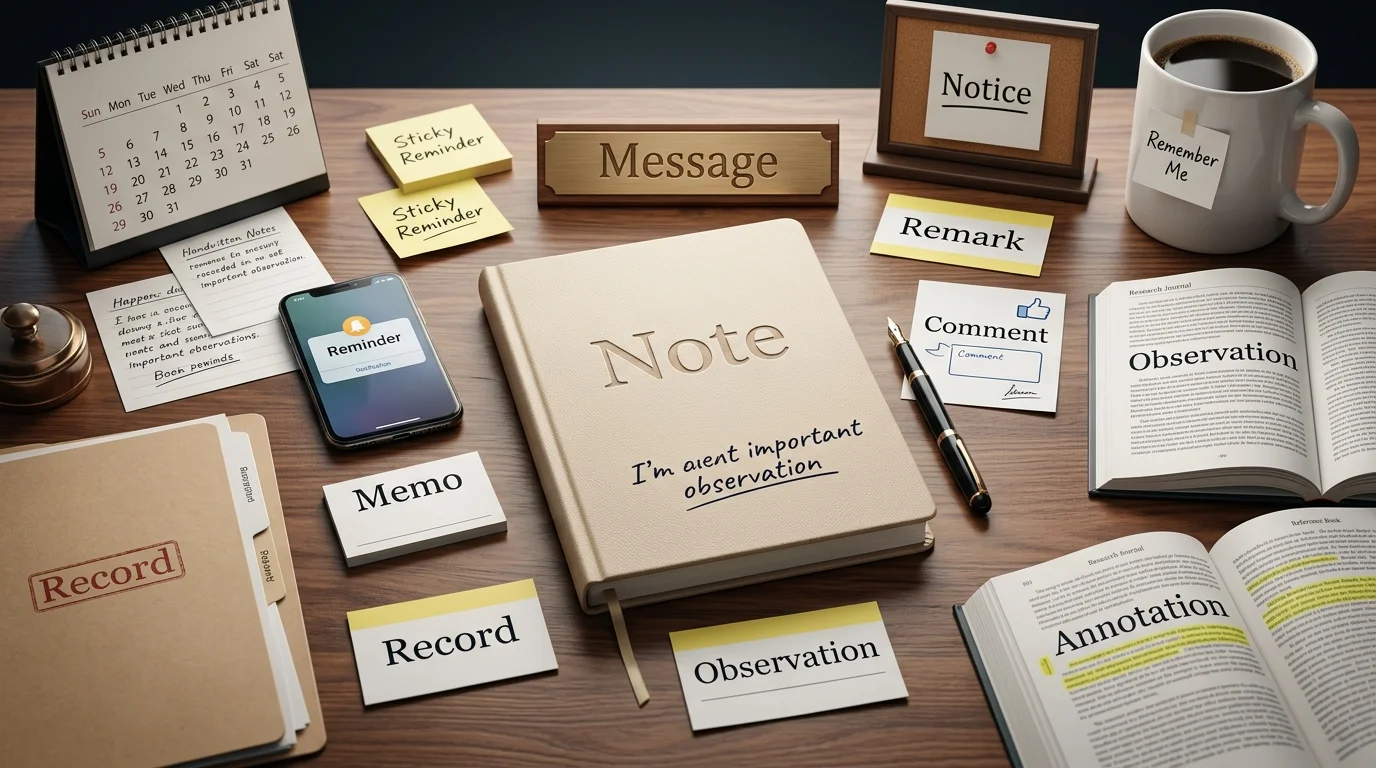
The biggest challenge with note is identifying its intended sense before choosing an alternative.
Ask what note means in the sentence:
Is it a short message?
Is it a reminder?
Is it an observation?
Is it a formal record?
Is it a comment?
Does it mean “notice” as a verb?
Is it referring to music?
Does it mean paper currency?
Once you identify the meaning, the synonym becomes much easier to choose.
For example:
She left a note on the desk.
Use message if it is simply communication.
She left a reminder on the desk.
Use reminder if the purpose is remembering a task.
She made an observation about the report.
Use observation when note means a thoughtful comment.
Precision is more valuable than replacing a common word with a more complicated one.