


50+ Synonyms for Debris by Meaning and Context
Debris refers to scattered pieces, waste, or remains left after something breaks, is destroyed, or accumulates over time. The following alternatives have different meanings, so they are grouped by context.
1. Synonyms for Debris Meaning Broken Pieces and Fragments
These words describe small or separated pieces of something that has broken apart.
Fragments — Small pieces separated from a larger object.
Example: Fragments of glass covered the floor.Pieces — Individual parts of something larger.
Example: Pieces of the broken chair lay scattered across the room.Shards — Sharp pieces of broken glass, pottery, or similar materials.
Example: Workers carefully removed the shards from the sidewalk.Splinters — Thin, sharp pieces broken off wood or another material.
Example: Splinters from the damaged fence were scattered across the yard.Splinters and fragments — Small broken parts, especially when describing mixed materials.
Example: Splinters and fragments remained after the wooden crate collapsed.Chips — Small pieces broken or cut from a larger surface.
Example: Stone chips covered the workshop floor.Slivers — Very thin, narrow pieces of a material.
Example: Slivers of glass were found near the window.S fragments — Not a standard English expression; use fragments or small fragments instead.
Example: Small fragments of the ceramic bowl remained.Broken pieces — A straightforward expression for parts of a damaged object.
Example: They swept the broken pieces into a dustpan.Shavings — Thin strips or small particles removed from wood, metal, or another material.
Example: Wood shavings collected beneath the workbench.
2. Synonyms for Debris Meaning Rubble and Wreckage
These words are especially useful for describing destruction, demolition, accidents, and damaged structures.
Rubble — Broken bricks, stones, concrete, or masonry.
Example: The demolition left a pile of rubble behind.Wreckage — The remains of something badly damaged or destroyed.
Example: Investigators examined the wreckage of the vehicle.Ruins — The remains of a building or structure that has been destroyed or decayed.
Example: Visitors explored the ruins of the ancient fortress.Crumble — Usually a verb meaning to break into small pieces; crumbs or crumbling remains may fit as nouns.
Example: The old wall crumbled into pieces.Remains — What is left after something has been destroyed, removed, or used.
Example: The remains of the damaged building were cleared away.Rubble pile — A collection of broken masonry and construction materials.
Example: A rubble pile blocked the entrance to the site.Shattered remains — Pieces left after an object breaks violently.
Example: The shattered remains of the vase were carefully collected.Demolition waste — Material left after a structure is demolished.
Example: The contractor arranged for the demolition waste to be recycled.Structural remains — Parts of a building or other structure that still exist after damage or collapse.
Example: Engineers inspected the structural remains after the storm.Wreck — A badly damaged object, vehicle, or structure; it can refer to the damaged thing itself rather than loose debris.
Example: The wreck of the old boat remained near the shore.
3. Synonyms for Debris Meaning Waste and Discarded Material
Use these terms when debris consists of unwanted material, rubbish, or items that have been thrown away.
Waste — Material that is no longer wanted or useful.
Example: The factory disposed of its waste responsibly.Refuse — Discarded material or rubbish, often in a formal or technical context.
Example: The city collected refuse from residential streets.Rubbish — Unwanted or discarded material; common in British English.
Example: The workers removed rubbish from the empty lot.Trash — Discarded material; common in American English.
Example: Trash accumulated around the abandoned building.Garbage — Unwanted material, especially everyday household waste.
Example: The crew cleared garbage from the park.Litter — Waste carelessly left in a public or outdoor place.
Example: Volunteers picked up litter along the beach.Scraps — Small leftover pieces of material or food.
Example: Metal scraps were collected for recycling.Offcuts — Pieces left over after cutting material to size.
Example: The carpenter saved the wood offcuts for another project.Discarded material — Items or substances that have been thrown away or abandoned.
Example: The team sorted the discarded material before disposal.Junk — Informal term for unwanted, useless, or low-value items.
Example: The garage was filled with junk and broken equipment.
4. Synonyms for Debris Meaning Remnants and Leftovers
These alternatives emphasize what remains after a process, event, or activity.
Remnants — Small remaining parts of something that once existed in greater quantity.
Example: Remnants of the old wall were visible beneath the soil.Residue — Material left behind after a process, substance, or event.
Example: A sticky residue remained on the table.Detritus — Accumulated waste, fragments, or remains; often used in formal or descriptive writing.
Example: Rain washed the forest detritus into the stream.Leftovers — Things remaining after the main part has been used or consumed.
Example: Leftovers from the repair project were stored in a container.Remainder — The part that is left after some has been removed or used.
Example: The remainder of the material was taken to a recycling center.Traces — Small signs or amounts of something that remain.
Example: Traces of the old paint remained on the wall.Residuum — A formal term for material left behind after a process.
Example: The analysis identified a mineral residuum.By-products — Secondary materials produced during a process; not always waste.
Example: The manufacturing process produced by-products that could be reused.Ash — Powdery material left after something burns.
Example: Ash and charred fragments covered the fireplace.Detrital material — Loose particles or fragments produced by breakdown or erosion.
Example: Detrital material collected at the base of the slope.
5. Synonyms for Debris in Nature and the Environment
These words describe material scattered or accumulated by natural processes.
Driftwood — Wood carried by water and deposited along shores.
Example: Driftwood and other natural debris lined the beach.Fallen branches — Tree limbs that have broken or fallen to the ground.
Example: The crew cleared fallen branches after the storm.Leaf litter — Fallen leaves and other plant material covering the ground.
Example: Insects sheltered beneath the leaf litter.Organic matter — Material derived from living organisms, including decomposing plants and animals.
Example: Organic matter accumulated in the garden bed.Sediment — Particles that settle at the bottom of water or accumulate on a surface.
Example: Sediment and debris collected near the riverbank.Erosion material — Soil, rock, and other particles moved by erosion.
Example: Erosion material washed down the hillside.Storm debris — Material scattered or left behind by severe weather.
Example: The town organized volunteers to clear storm debris.Flood debris — Material carried or deposited by floodwater.
Example: Flood debris blocked several drainage channels.Vegetation waste — Discarded plant material such as leaves, branches, and grass.
Example: The landscaping crew removed vegetation waste.Natural detritus — Naturally occurring fragments and decomposing material.
Example: Natural detritus enriched the forest soil.
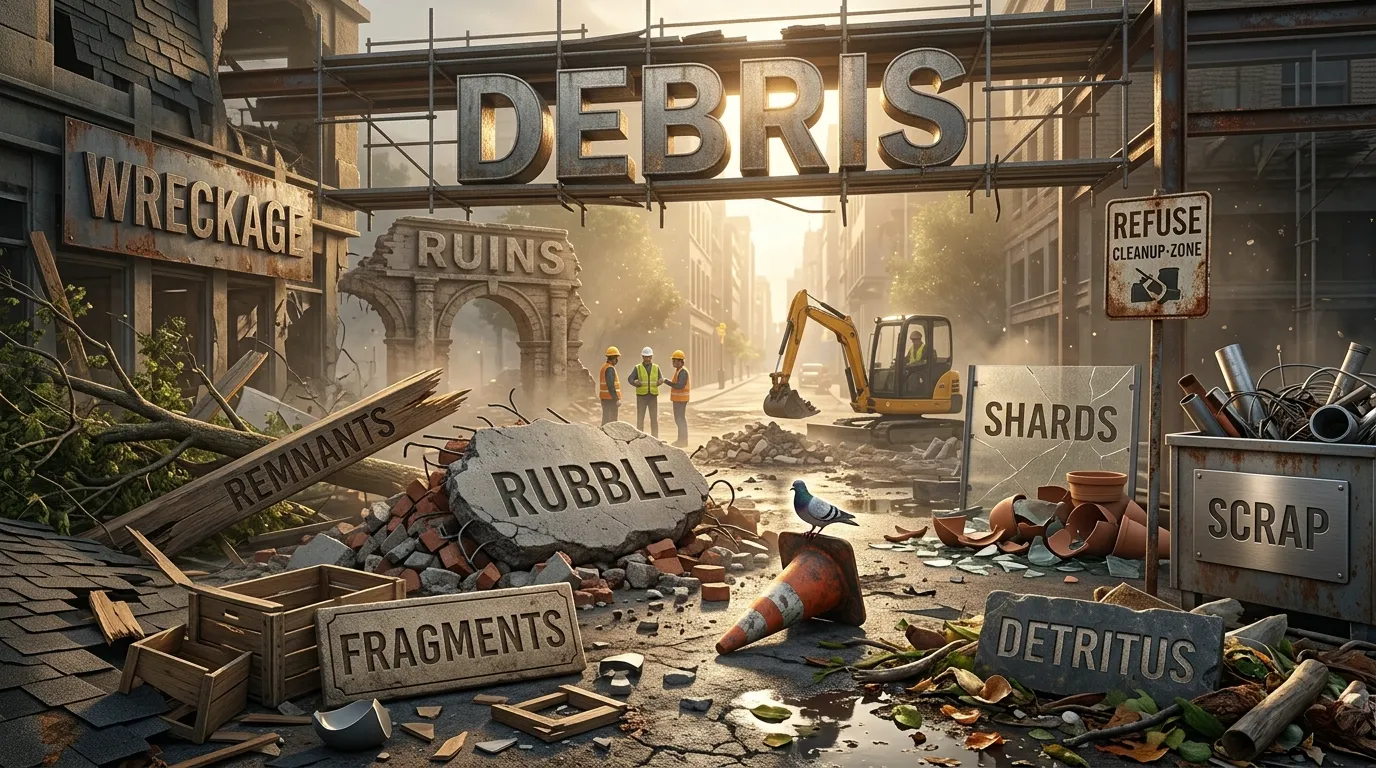
Quick Synonym List for Debris
Here are useful alternatives to debris:
Rubble
Wreckage
Fragments
Remains
Remnants
Shards
Splinters
Chips
Slivers
Waste
Refuse
Rubbish
Trash
Garbage
Litter
Scraps
Offcuts
Junk
Detritus
Residue
Leftovers
Remainder
Traces
Demolition waste
Storm debris
Best Synonyms for Debris by Context
| ContextBest synonyms | |
|---|---|
| Broken glass or pottery | Shards, fragments, slivers |
| Demolished buildings | Rubble, wreckage, demolition waste |
| Vehicle accidents | Wreckage, fragments, broken pieces |
| Household waste | Trash, garbage, rubbish |
| Public spaces | Litter, rubbish, waste |
| Woodworking | Offcuts, shavings, splinters |
| Forest floors | Leaf litter, natural detritus, organic matter |
| Floods and storms | Flood debris, storm debris, fallen branches |
| Material left after a process | Residue, remnants, residuum |
| Riverbeds and shorelines | Sediment, driftwood, natural debris |
Debris vs. Similar Words: What’s the Difference?
| Word | Meaning | Best use |
|---|---|---|
| Debris | Scattered pieces or material left behind | General descriptions of scattered remains |
| Rubble | Broken masonry, bricks, stones, or concrete | Construction and destruction |
| Wreckage | Remains of something severely damaged | Accidents, crashes, destroyed structures |
| Fragments | Individual pieces broken from a larger whole | Glass, pottery, metal, or other objects |
| Remnants | What remains of something after most of it is gone | Historical, physical, or figurative contexts |
| Detritus | Accumulated waste or fragments | Formal, scientific, or descriptive writing |
| Litter | Waste carelessly left in a place | Parks, streets, beaches |
| Refuse | Discarded material | Waste management and technical writing |
| Residue | Material remaining after a process | Chemistry, cleaning, manufacturing |
| Scraps | Small leftover pieces | Food, fabric, wood, and metal |
| Ruins | Remains of a damaged or decayed structure | Buildings and historical sites |
| Sediment | Particles that settle or accumulate | Rivers, lakes, soil, and geology |
10 Sentence Transformations Using Synonyms for Debris
Original: Debris covered the road after the storm.
Revised: Storm debris covered the road after the storm.Original: Workers cleared debris from the demolished building.
Revised: Workers cleared rubble from the demolished building.Original: Debris surrounded the damaged vehicle.
Revised: Wreckage surrounded the damaged vehicle.Original: Debris from the broken window lay on the floor.
Revised: Shards of glass from the broken window lay on the floor.Original: The beach was covered with debris.
Revised: The beach was covered with litter and driftwood.Original: The workers removed debris from the construction site.
Revised: The workers removed construction waste from the site.Original: Debris accumulated beneath the trees.
Revised: Leaf litter and fallen branches accumulated beneath the trees.Original: The machine left debris on the workbench.
Revised: The machine left scraps and metal shavings on the workbench.Original: Debris remained after the fire.
Revised: Ash and charred fragments remained after the fire.Original: The river carried debris downstream.
Revised: The river carried floating fragments and waste downstream.
Common Mistakes When Using Synonyms for Debris
Using “rubble” for every type of debris: Rubble usually refers to broken stone, brick, or concrete.
Confusing “wreckage” with “litter”: Wreckage results from serious damage; litter is waste carelessly left behind.
Using “residue” for large broken objects: Residue usually means material left behind after a process.
Treating “remnants” and “fragments” as identical: Fragments are pieces; remnants emphasize what remains.
Using “detritus” in casual conversation unnecessarily: It is often more formal or literary than trash or debris.
Calling all natural material “waste”: Fallen leaves and branches can be natural debris or organic matter rather than discarded waste.
Using “ruins” for loose material alone: Ruins generally describe the remains of a structure or place.
Assuming “by-products” always means debris: By-products can be useful materials created during a process.
Using “litter” for debris inside a demolition site: Construction debris or rubble is usually more precise.
Ignoring the material and source: The best synonym depends on whether the material is broken glass, concrete, household waste, or natural matter.
How to Choose the Right Synonym for Debris
For broken buildings: Choose rubble, wreckage, or demolition waste.
For broken objects: Choose fragments, shards, splinters, or pieces.
For unwanted household material: Choose trash, garbage, rubbish, or refuse.
For waste in public spaces: Choose litter.
For natural material: Choose leaf litter, driftwood, sediment, or natural detritus.
For material left after a process: Choose residue, remnants, or residuum.
For formal or scientific writing: Choose detritus, residue, or detrital material when technically accurate.
For storm or flood damage: Choose storm debris or flood debris.